


650-ft-tall tower concept with a hotel proposed to replace stalled project at north end of Granville Street Bridge in downtown Vancouver


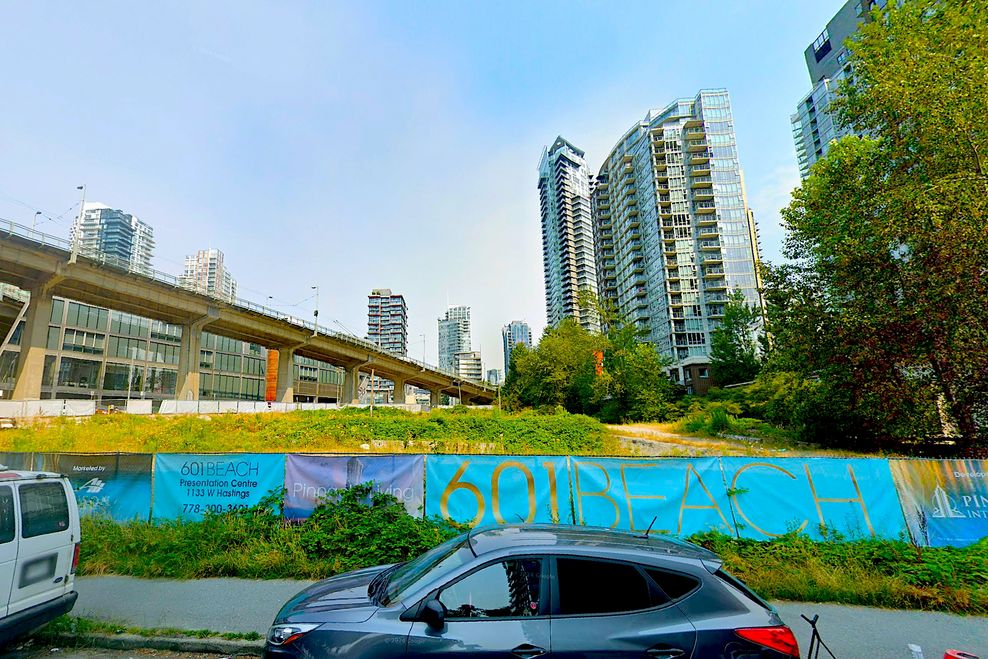
Pinnacle International is making a renewed attempt to move forward with its long-stalled, mixed-use tower development at the north end of the Granville Street Bridge in downtown Vancouver.
It is proposing to significantly increase density through verticality — which would make it the second-tallest building within the city of Vancouver if built today — and introduce additional significant uses, specifically a major hotel.
Earlier this month, the developer submitted a new rezoning application for its site at 601 Beach Crescent, located immediately east of the bridge’s Seymour Street off-ramp — opposite Westbank’s Vancouver House tower.
- You might also like:
- New renderings of Western Canada's tallest tower in downtown Vancouver, featuring an observation deck attraction
- City of Vancouver staff can't prove it maximized value in some land sales: eight-year audit
- 27-storey social housing tower planned by City of Vancouver for Granville Bridge's north end
- New 33-storey hotel tower for Granville Entertainment District approved by Vancouver City Council
- New 35-storey hotel and rental housing tower proposed for Helmcken Street in Granville Entertainment District
The rezoning application has yet to be publicized to initiate the formal notification and public consultation process, but this is anticipated soon.
However, the City’s public records indicate that the proposal is for a 650-ft-tall building with 67 storeys.
In contrast, the neighbouring Vancouver House stands at 493 ft.
For further comparison, Vancouver’s current tallest building, Park Hyatt Vancouver (formerly known as Living Shangri-La Vancouver until 2025), stands at 659 ft, while the second-tallest building, Paradox Hotel Vancouver, is 616 ft.
Metro Vancouver’s tallest building is currently the 708-ft-tall Two Gilmore Place in Burnaby, completed in 2024, which is expected to be surpassed by the 755-ft-tall Grand Tower of Concord Metrotown later this year. The tallest building proposed for the region would also be Western Canada’s highest — the 1,034-ft-tall hotel and observation tower for downtown Vancouver’s Bay parkade redevelopment, where there would also be two additional mixed-use residential and commercial towers reaching 889 ft. and 783 ft.
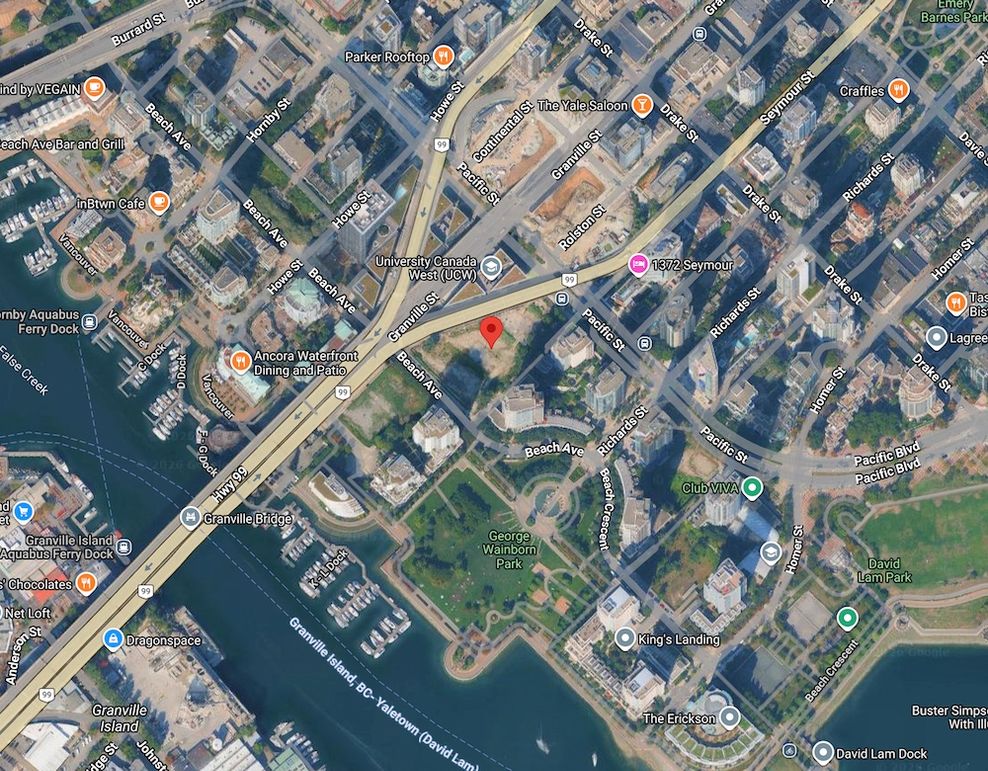
Site of 601 Beach Crescent, Vancouver. (Google Maps)
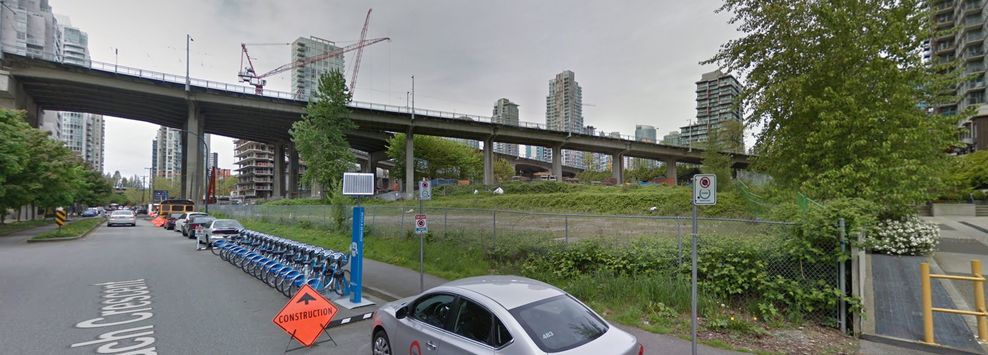
Site of 601 Beach Crescent, Vancouver. (Google Maps)
The newly revised concept for the Pinnacle project includes a 12-storey base podium, above which the tower rises vertically to create an additional gateway landmark at the bridge entrance into Vancouver’s city centre. Relaxations to the City’s protected mountain view cone policies in recent years likely contributed to this design shift.
This new application proposes 480 strata market ownership condominium homes, a hotel with 206 guest rooms, 152 social housing units, and ground-level retail and restaurant space, along with three levels of underground parking. The hotel component is a newly introduced use in this revised mixed-use project. Overall, the building would have a floor area ratio (FAR) of nearly 13, meaning the total floor area would be almost 13 times the size of the 1.43-acre site.
At this time, no further project details or conceptual renderings have been made public.
In contrast, the previous rezoning application approved by Vancouver City Council in 2020 proposed a 535-ft-tall, 55-storey tower with 303 strata market ownership condominium homes, 152 social housing units, and 23,000 sq ft of ground-level retail and restaurant space. It had a FAR of 7.6, along with three levels of underground parking.
The project underwent minor revisions in 2021 during the development permit application process, reducing its height to 521 ft and 53 storeys, with no changes to uses or density. The developer subsequently entered the presale stage for the condominiums, with an aim to reach completion in 2027, but its efforts were hampered by challenging market conditions.
The added hotel use is a move that likely improves the project’s financial and economic feasibility. Pinnacle is also an experienced hotel owner and operator, with existing properties such as Marriott Vancouver Pinnacle Downtown Hotel, Pinnacle Vancouver Harbourfront Hotel, Pinnacle Hotel at The Pier in North Vancouver, and Pinnacle Hotel Whistler Village, as well as the upcoming Le Meridien Richmond Pinnacle and Elements by Westin hotels next to SkyTrain’s Capstan Station in Richmond.
The original lead design firm, Jyom Architecture, has been retained for the latest project revision.
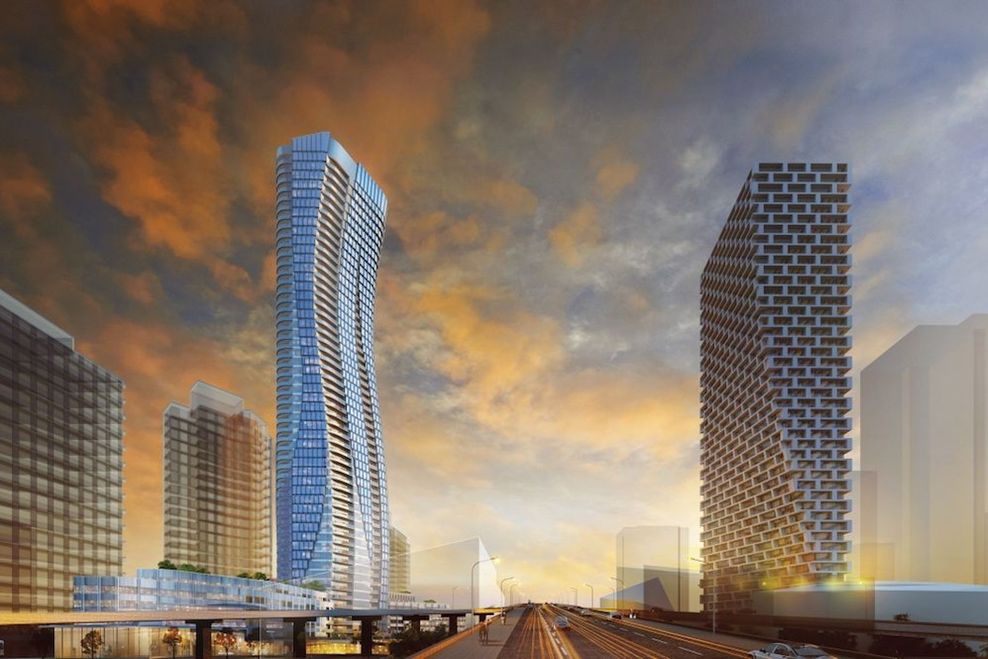
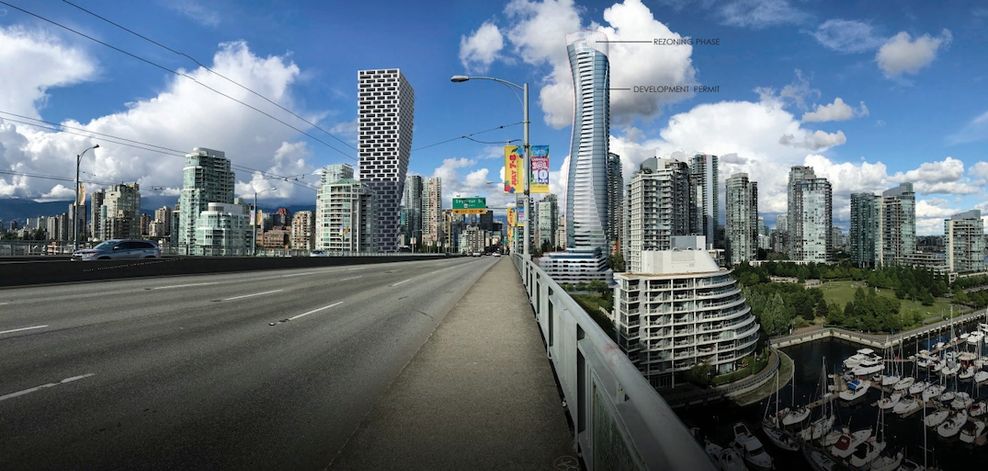
Cancelled concept: October 2019 artistic rendering of the planned tower at 601 Beach Crescent (left), with the existing Vancouver House tower also depicted (right). (Jyom Architecture/GBL Architects/Pinnacle International)
Cancelled concept: 2021 artistic rendering of the revised design for 601 Beach Crescent, Vancouver. (Jyom Architecture/GBL Architects/Pinnacle International)
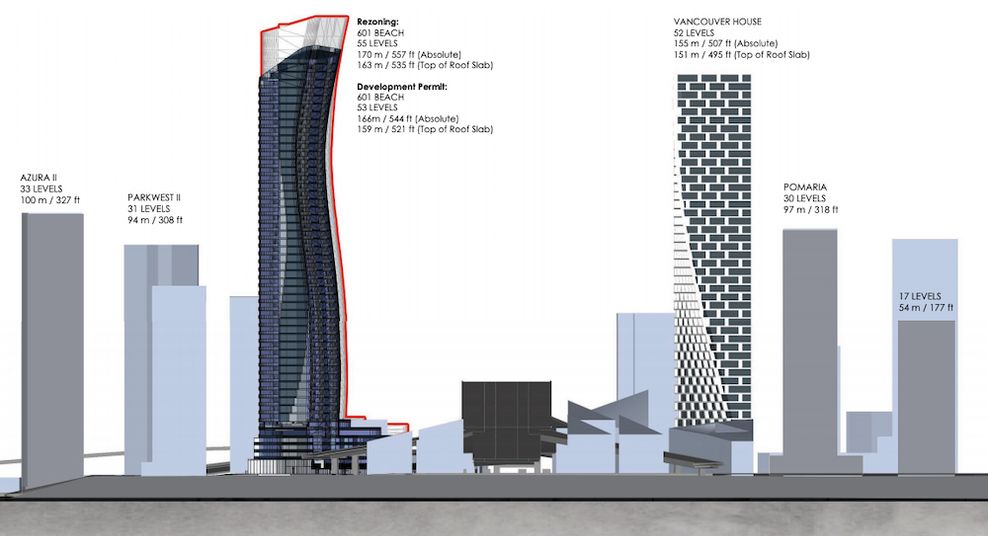
Cancelled concept: 2021 artistic rendering of the revised design for 601 Beach Crescent, Vancouver. (Jyom Architecture/GBL Architects/Pinnacle International)
This past winter, Pinnacle’s 2016 acquisition of 601 Beach Crescent from the City of Vancouver was heavily scrutinized in a report by the municipal government’s independent Auditor General on City staff’s land deals.
The audit of the City of Vancouver’s land sales highlights broad systemic issues in how the City manages, evaluates, and reports major real estate transactions — and the deal involving 601 Beach Crescent serves as a clear example of these problems in practice.
Overall, the Auditor General found that the City lacks a consistent, strategic approach to selling land. Instead of proactively planning transactions to maximize long-term public value, most deals — including large ones — are reactive and often initiated by developers. Weak policies, inconsistent documentation, and limited transparency mean the City cannot clearly demonstrate that it achieved the best possible outcomes for taxpayers. Importantly, while no corruption was found, the negotiations-based system itself is described as too informal and opaque for decisions involving hundreds of millions of dollars.
The 601 Beach Crescent transaction illustrates these structural issues. The property was sold in 2016 with a complex pricing structure that included a deferred payment tied to future rezoning. Auditors identified a calculation error by City staff in that adjustment price, leading to an estimated $13 million understatement in what the developer owes the City.
Beyond the calculation error, the deal also exposed governance and transparency concerns. Although the contract initially required the developer to handle certain affordable housing contributions, the City later agreed to cover a $12.1 million community amenity contribution (CAC) itself. Auditors found no clear documentation explaining this reversal and no evidence that City Council approved it. This reflects a broader pattern identified in the audit: key decisions and trade-offs were not consistently documented or fully communicated to elected officials.
- You might also like:
- New renderings of Western Canada's tallest tower in downtown Vancouver, featuring an observation deck attraction
- City of Vancouver staff can't prove it maximized value in some land sales: eight-year audit
- 27-storey social housing tower planned by City of Vancouver for Granville Bridge's north end
- New 33-storey hotel tower for Granville Entertainment District approved by Vancouver City Council
- New 35-storey hotel and rental housing tower proposed for Helmcken Street in Granville Entertainment District