


What we know about the improved design of BC Ferries' New Major Vessels


In recent months, much has been said about the controversy over BC Ferries’ decision to award its historic shipbuilding contract for the four New Major Vessels fleet to a state-owned shipyard in Mainland China.
What has received far less attention, however, is the significance of the vessels themselves.
This new generation of ships will become the largest in BC Ferries’ history — surpassing even the two Spirit-class flagships, the Spirit of British Columbia and the Spirit of Vancouver Island.
- You might also like:
- Opinion: B.C. shipyards are currently building for the Canadian Coast Guard and Navy, but can they also take on BC Ferries' future ships?
- Opinion: BC Ferries needs more new big ships much sooner than later
- BC Ferries selects state-owned shipyard in China to build four new major vessels
- BC Ferries approved to order four new major vessels, instead of five
- Premier David Eby rules out cancelling BC Ferries' China-built ships contract
- Federal infrastructure bank to provide BC Ferries with $1-billion loan toward China-built ships
BC Ferries’ first hands-on approach to design new ships
For the first time, BC Ferries has taken the lead in creating the vessel designs, working closely with a team of design contractors — naval architects and maritime engineers led by the Norwegian firm LMG Marin AS. This collaboration produced a basic design template for the new generation fleet.
In the past, BC Ferries would simply set out a list of requirements — things like overall technical standards, performance targets, and passenger amenities — and then leave it up to the shipyard to come up with the vessel’s precise design as part of their proposal. For the New Major Vessels project, however, BC Ferries has taken a very different approach. This time, the company played a hands-on role in shaping the design from the start, before choosing a shipyard and awarding the construction contract.
Such a process also served to provide bidding shipyards with a comprehensive common starting point to develop their proposals for costs, schedules, and detailed designs, with the intention of minimizing shipyard risk and lowering overall costs.
Moreover, this new standardized class of the largest ships for BC Ferries will eventually replace not only all of the aging C-class and remaining V-class vessels, but also the Spirit-class ships over the longer term.
Over time, BC Ferries intends to reduce the number of different vessel classes to six classes, with a minimum number of models in each class — each interoperable with the other. All of these different vessel classes would also be supported by five berth types, with the vessels and terminals sharing common designs, layouts, equipment, and operating and maintenance practices.
In particular, the New Major Vessels are specifically designed to operate on any of BC Ferries’ four busiest routes, which connect Metro Vancouver with Vancouver Island and the Sunshine Coast.
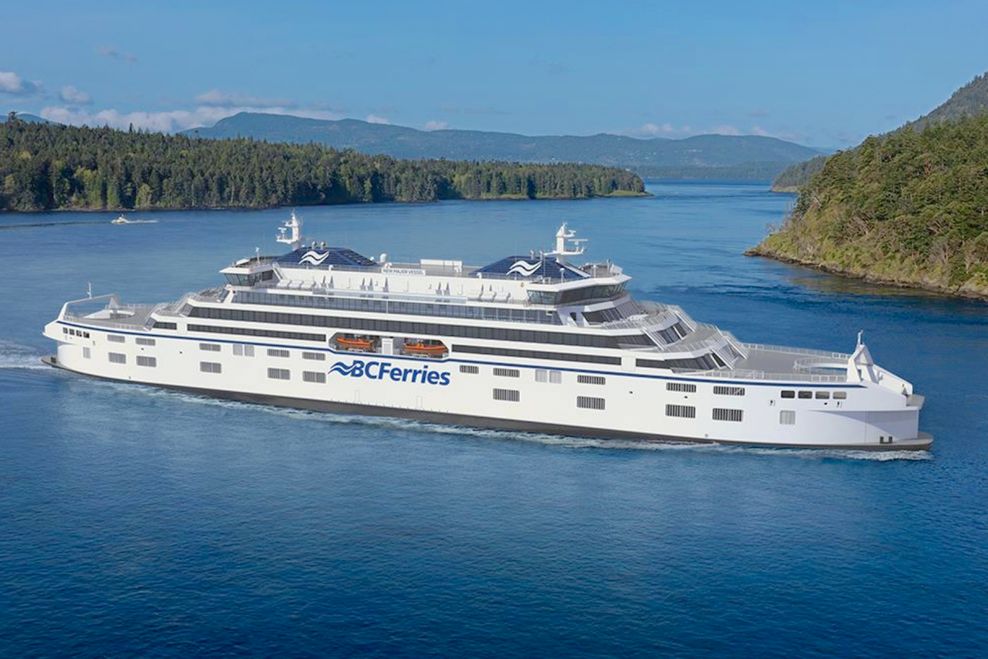
Artistic rendering of the New Major Vessels. (BC Ferries)
By introducing interoperable, standardized ships across these corridors, BC Ferries not only benefits from the modern design improvements of the new vessels but also gains greater operational flexibility. Vessels can be reassigned between routes with minimal disruption, as crews would not require extensive retraining to adapt to different ship classes. This added trained workforce flexibility could help the ferry service better manage staffing shortages and improve overall reliability.
However, as the New Major Vessels are larger ships to better meet current and long-term transportation demand, they are likely to require more crew and fuel to operate. Currently, it takes roughly 50 crew to operate each Spirit-class vessel and approximately 35 crew to operate a C-class or Coastal-class vessel.
The New Major Vessels will have a length of 172 metres, a width of 27.6 metres, and a maximum displacement of 11,800 tonnes. Each ship can accommodate 2,100 passengers and crew, 358 cars, and 34 semi trucks.
These future ships will be slightly larger than the current largest ships, the Spirit-class, which run on the critically important Tsawwassen-Swartz Bay route. The two Spirit-class ships have a length of 167 metres, a width of 27.1 metres, and a maximum displacement of 11,681 tonnes, and a capacity for 2,100 passengers and crew, 358 cars, and 34 semi trucks.
The main car deck will also have dedicated facilities for 20 bike stalls to support the growth in passengers who access the ferry terminals by cycling.
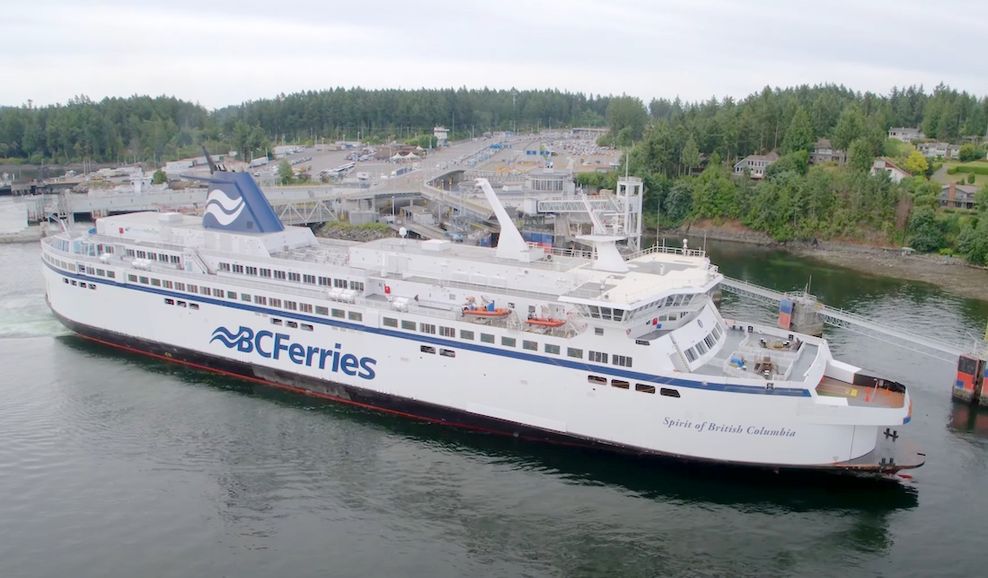
Spirit of British Columbia vessel. (BC Ferries)
Moreover, BC Ferries notes that the overall increase in passenger capacity is intended to support future higher foot passenger volumes accessing the ferry terminals by public transit and using park-and-ride services.
The first four New Major Vessels to be built in China will enter service from 2029 to 2031, directly replacing three C-class vessels — Queen of Alberni, Queen of Coquitlam, and Queen of Cowichan — and one V-class vessel, the Queen of New Westminster.
A future additional order of two New Major Vessels will be made at a later time, potentially entering service around 2037, with a chorus of elected officials calling for these vessels to be built in Canada. These two additional ships will replace the C-class vessels of the Queen of Oak Bay and Queen of Surrey, which BC Ferries had originally hoped to retire earlier, but will now see some upgrades at local shipyards to extend their lifespans by a few more years.
The typical C-class vessel has a length of 139 metres, a width of 27.1 metres, and a maximum displacement of roughly 6,500 tonnes, as well as a capacity for 1,494 passengers and crew, 316 cars, and 12 semi trucks. Simply put, the New Major Vessels will be considerably larger than the C-class vessels they will primarily replace.
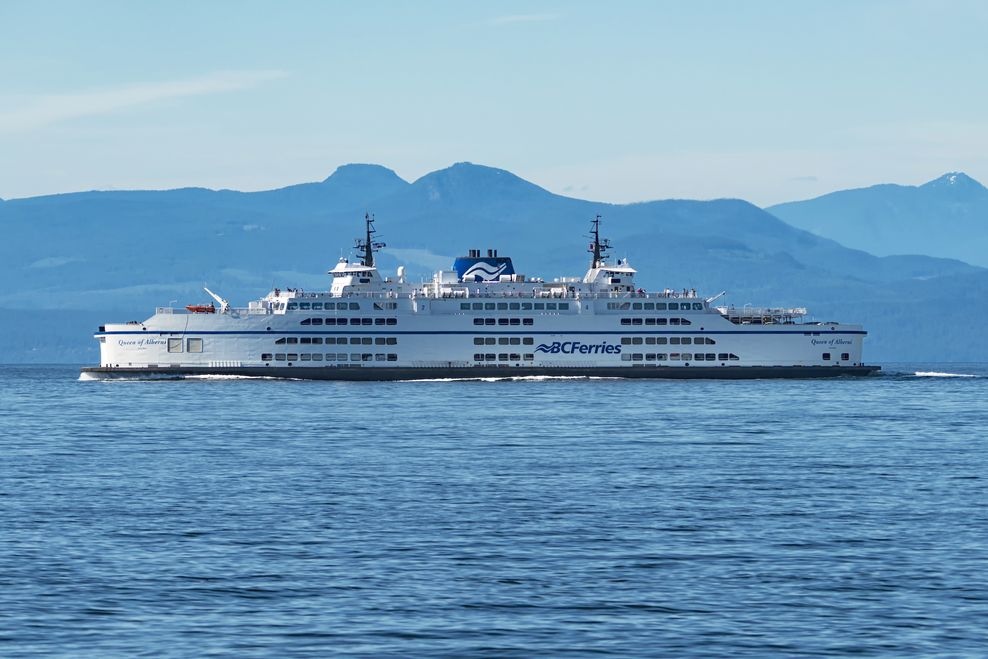
Queen of Alberni vessel of BC Ferries. (poemnist/Shutterstock)
BC Ferries’ first indoor pet lounge on a passenger deck
There are also some clear, significant design changes compared to what local ferry passengers are used to on the four major routes.
The New Major Vessels will feature three indoor passenger decks — an increase from two on the Spirit-class and Coastal-class vessels, and just one on the older C-class ships.
Artistic renderings and preliminary deck layouts released by BC Ferries show a more compact, vertically integrated superstructure. The three indoor passenger decks do not extend the full length of the vessel; instead, each successive level is smaller than the one below it, creating a stepped design.
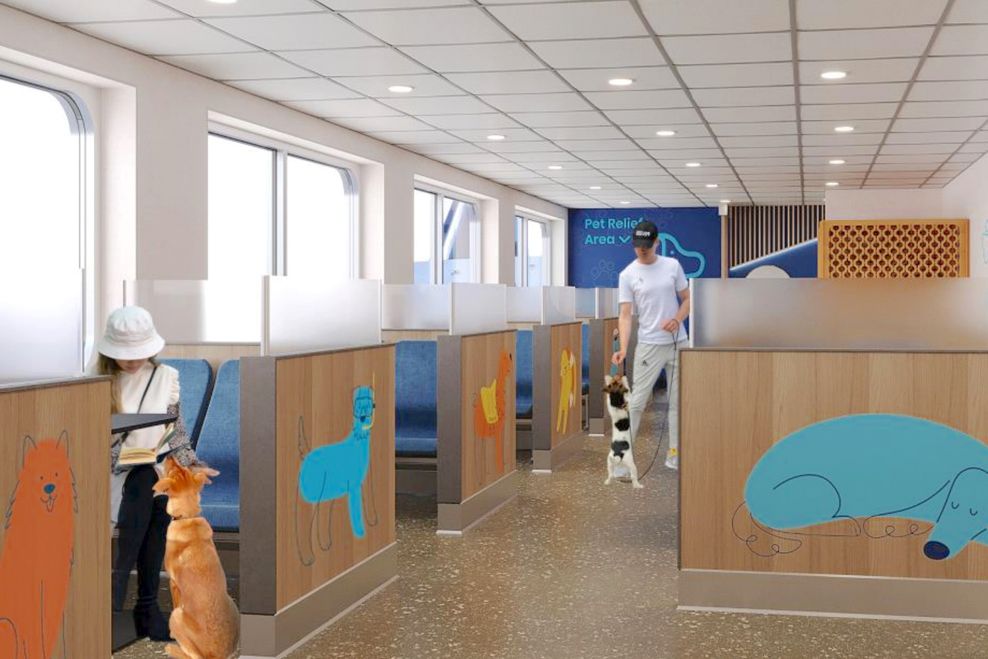
On the lowermost indoor passenger deck of Deck 5, there will be extensive seating areas at both ends of the ship, as well as some food services (such as the Coast Cafe Express), a retail shop (such as the Passages Gift Shop), a children’s play area, and a designated indoor pet lounge.
This indoor pet lounge marks the first time in BC Ferries’ fleet that a designated pet area has been relocated from a vehicle deck to a passenger deck. The lounge will include stainless steel kennels in various sizes, banquette seating in semi-enclosed areas for owners and pets to sit together, a handwashing sink with hot and cold water, and pet relief areas equipped with artificial turf and a dog drinking fountain. The design provides a more comfortable environment for pets, free from the noise of car alarms that are often triggered by the movement of the vessels.
On the middle indoor passenger deck of Deck 6, there will be the main restaurant space (such as the Coastal Cafe) and extensive general seating areas along both sides of the ship.
The top and smallest indoor passenger deck of Deck 7 will see a large additional food services area — specifically, the Premium Lounge concept for these new generation vessels.
It is noted by the ferry corporation that compared to the existing ships, the children’s play area will be better equipped, the retail shop will be larger, the cafe will be improved, and the main restaurant will be larger.
Various washroom facilities will be found on both the fifth and sixth decks.
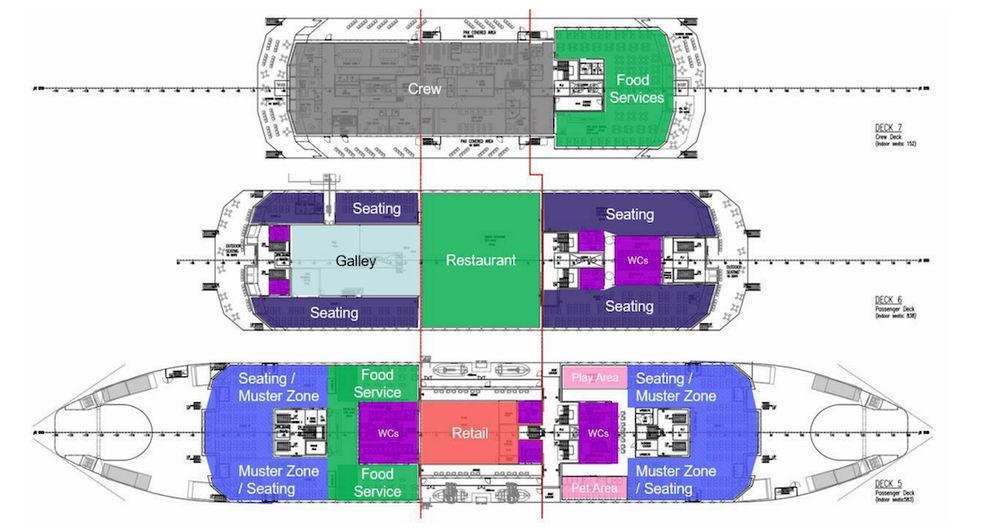
Layout of the three indoor passenger decks; concept of the New Major Vessels. (BC Ferries)
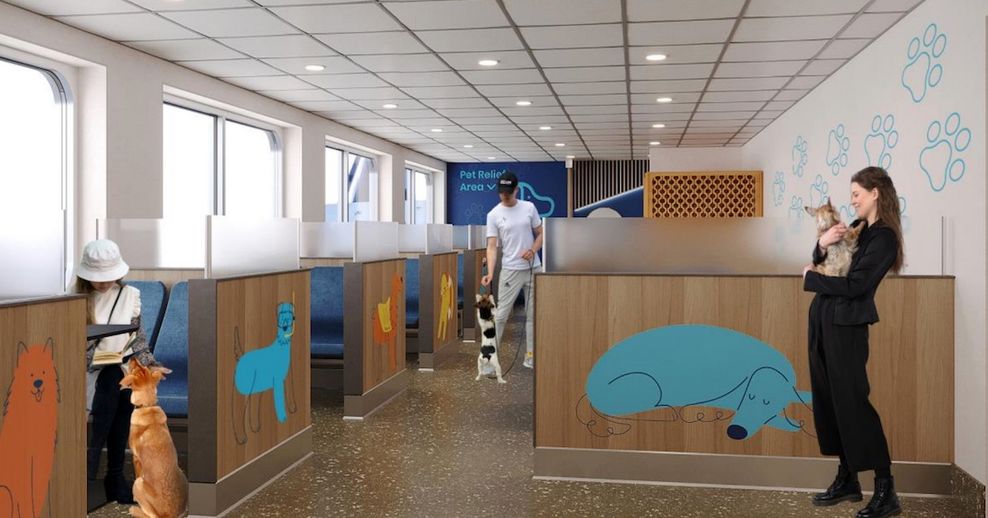
Indoor pet lounge on a passenger deck; artistic rendering of the New Major Vessels. (BC Ferries)
A BC Ferries spokesperson told Daily Hive Urbanized there will be a combined total of 1,650 seats for passengers across the indoor passenger decks, which exceeds the approximate 1,475 seats found on the current major vessels. The bulk of this seating will be found on Deck 6.
This indoor seating capacity does not include the New Major Vessels’ outdoor seating areas on the terraces on both ends of the ship, created by the stepped design on decks 6 and 7. Moreover, Deck 7 also features extensive covered outdoor seating areas along the sides of the ship, which, combined with the open-air outdoor terraces on the ends of the ship, create a full walk-around promenade on this particular deck with 360-degree views. Altogether, each vessel will have outdoor seating for about 240 passengers.
Below the three indoor passenger decks, the vessels will feature two car decks, each with extensive design improvements aimed at enhancing capacity and efficiency.
Both car decks will be able to accommodate significantly taller vehicles — a height limit of 2.9 metres for the upper deck and 4.7 metres for the main car deck, enabled by much higher ceiling heights and fewer obstructions. In contrast, the maximum vehicle heights for the existing major vessel fleet are 2.1 metres and 4.57 metres for Spirit-class vessels, 2.9 metres and 4.57 metres for the Coastal-class vessels, and 2.1 metres and 4.17 metres for the C-class vessels.
The vehicle ramp openings at both ends of the ship are wider to enable quicker loading and unloading of vehicles.
Furthermore, the New Major Vessels will feature partial open-air openings at both ends of the car decks, as well as the sides along the length of the ship, significantly improving air quality and ventilation. This continuous airflow could enable BC Ferries to allow passengers to remain in their vehicles during sailings. The ferry corporation notes that this design aligns with Transport Canada regulations, which may permit passengers to stay on open vehicle decks, subject to appropriate safety and operational reviews.
Currently, the vessels serving the major routes have fully enclosed car decks, which means passengers are prohibited from remaining in their vehicles under Transport Canada rules.
Unlike the Spirit-class vessels, but similar to the Coastal-class and C-class vessels, the New Major Vessels will have control bridges at each end of the ship to eliminate the need for a vessel to turn around at a ferry terminal, which will improve operational efficiency and reduce travel times.
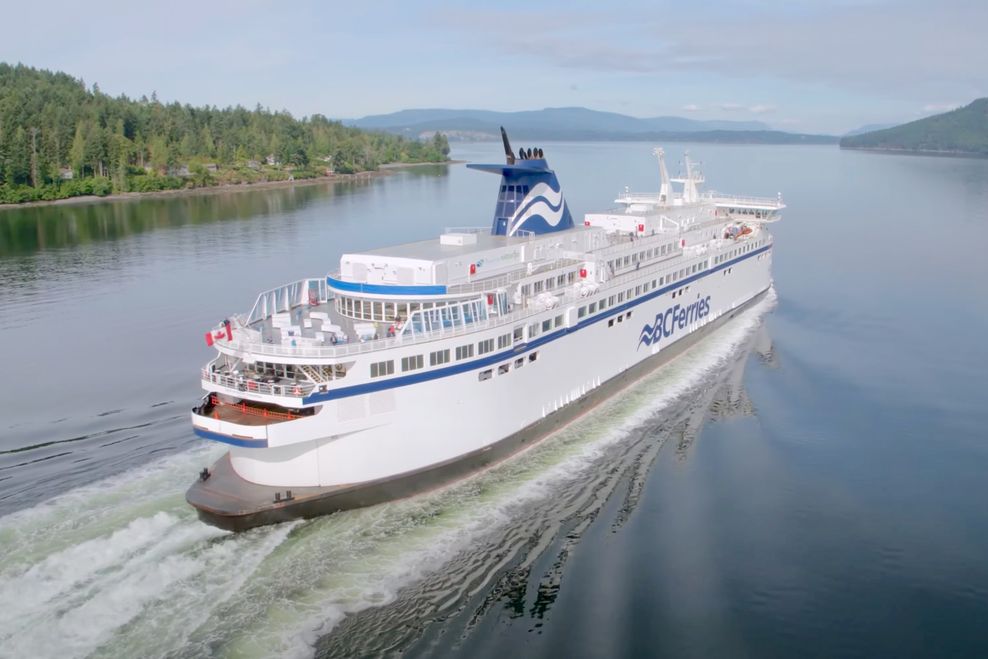
Spirit of British Columbia vessel. (BC Ferries)
Diesel-battery engines and without a rudder and fixed propellers
Unlike all existing major vessels in the fleet, the new ships will not be equipped with rudders or fixed propellers. Instead, they will use four azimuth propulsors — two mounted on each side of the hull — that can rotate 360 degrees, combining both propulsion and steering into a single system.
Azimuth propulsors are widely used on ships that require exceptional maneuverability and precise handling. They are especially common on modern cruise ships, tugboats, offshore supply vessels, icebreakers, and specialized research or construction vessels, and are increasingly being adopted on ferries. By contrast, they are far less common on conventional cargo ships and tankers, which prioritize straight-line efficiency over agility.
BC Ferries notes that equipping the vessels with four azimuth propulsors provides a level of operational redundancy not typically seen on major vessels, allowing operations to continue even if one propulsor were to fail.
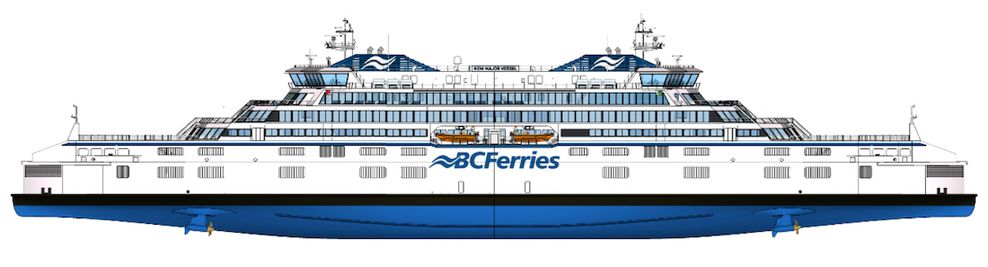
Artistic rendering of the New Major Vessels. (BC Ferries)
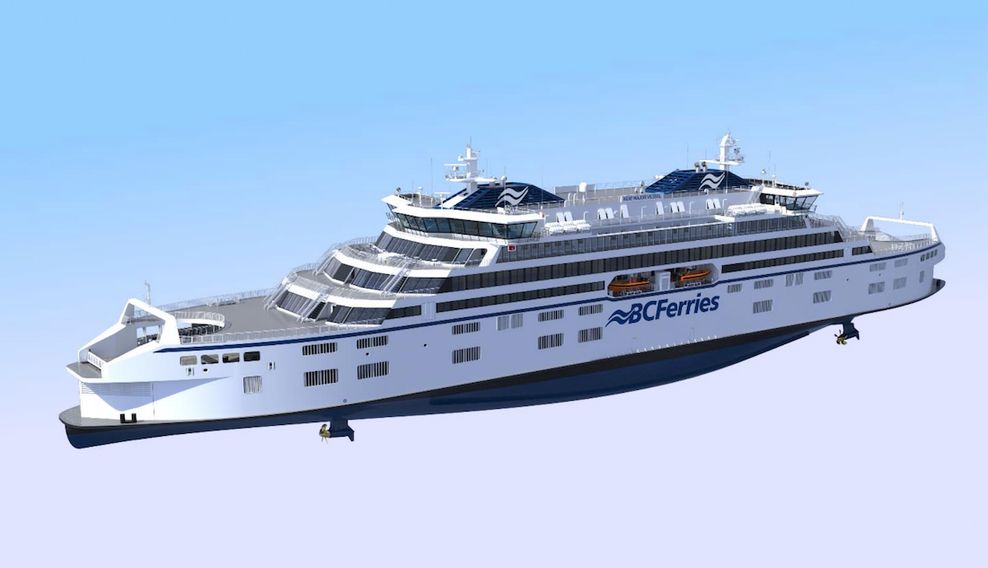
Artistic rendering of the New Major Vessels. (BC Ferries)
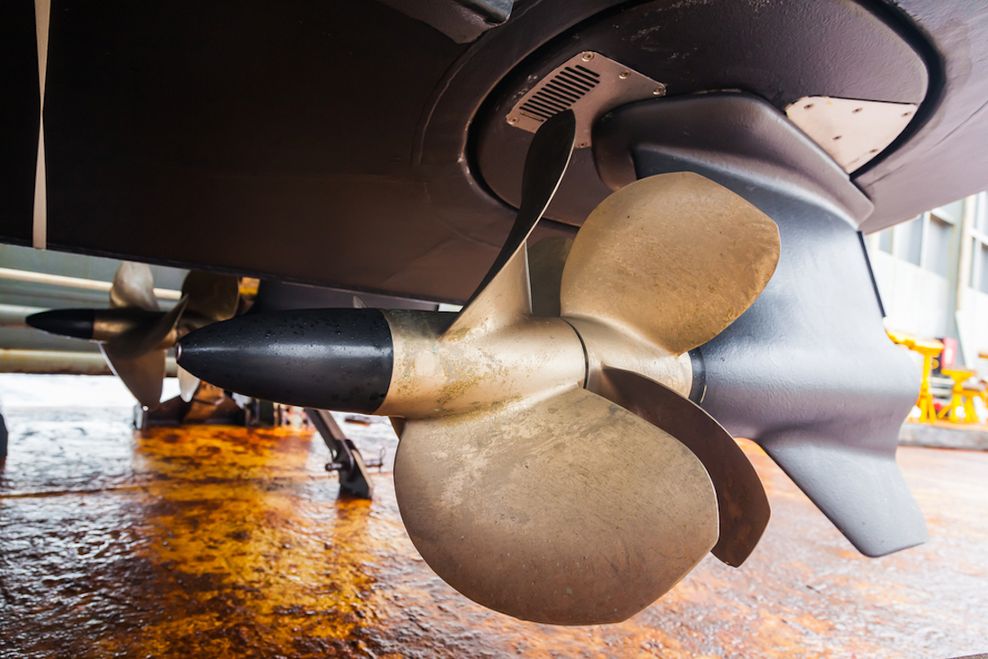
Example of azimulth propulsors. (ZHMURCHAK/Shutterstock)
Another major unconventional design aspect of the New Major Vessels is its diesel-battery hybrid engines, which will be capable of using B100 — 100 per cent pure biodiesel, which is a renewable fuel made from biomass such as vegetable oils, animal fats, and used cooking oil. This reduces emissions by up to 90 per cent, compared to the typical use of fossil fuel-based diesel.
The new ships will be outfitted with 10 MWh batteries — roughly equivalent to the combined storage capacity of 182 Tesla Model 3 vehicles — with an expected useful lifespan of 10 years. Under the diesel-battery hybrid system, the diesel engines will power electric generators that charge the batteries, which in turn drive the ship. Acting as a buffer, the batteries allow the diesel engines to be smaller than if they were powering the vessels directly, while enabling them to run continuously at a steady, fuel-efficient speed.
The vessels will also be built with extra space to accommodate additional batteries, allowing for full electrification in the future once major investments are made in charging infrastructure at ferry terminals and in new transmission power lines in partnership with BC Hydro.
BC Ferries expects that while 100 per cent battery-powered ferries will carry higher upfront capital costs, these expenses will be offset over time by operational savings from relying on grid electricity rather than diesel.
This will be BC Ferries’ second class of ship featuring diesel-battery hybrid engines, second to the small Island Class vessels first introduced a few years ago, serving minor routes. The Island Class ships are also convertible to full electric.
The combination of azimuth propulsors and smaller diesel engines will also yield other environmental benefits, significantly reducing underwater radiated noise and helping to protect marine life.
To protect the price competitiveness of future additional orders of the New Major Vessels, BC Ferries has not released the value of the contract awarded to the Chinese shipyard.
However, early this summer, federal Crown corporation Canada Infrastructure Bank announced it had provided BC Ferries with a low-cost loan of $1 billion for these vessels, including $690 million for the cost of buying the four New Major Vessels and $310 million for future ferry terminal infrastructure upgrades, specifically the installation of charging infrastructure for the ships.
No Canadian shipyards submitted a bid for the contract, primarily because they could not compete on price with international yards and were already tied up with major federal contracts — particularly for the Canadian Coast Guard and Royal Canadian Navy — leaving them unable to meet BC Ferries’ timeline to replace aging vessels and expand capacity.
- You might also like:
- Opinion: B.C. shipyards are currently building for the Canadian Coast Guard and Navy, but can they also take on BC Ferries' future ships?
- Opinion: BC Ferries needs more new big ships much sooner than later
- BC Ferries selects state-owned shipyard in China to build four new major vessels
- BC Ferries approved to order four new major vessels, instead of five
- Premier David Eby rules out cancelling BC Ferries' China-built ships contract
- Federal infrastructure bank to provide BC Ferries with $1-billion loan toward China-built ships