


Opinion: Sea to Sky railway vision needs immediate government action


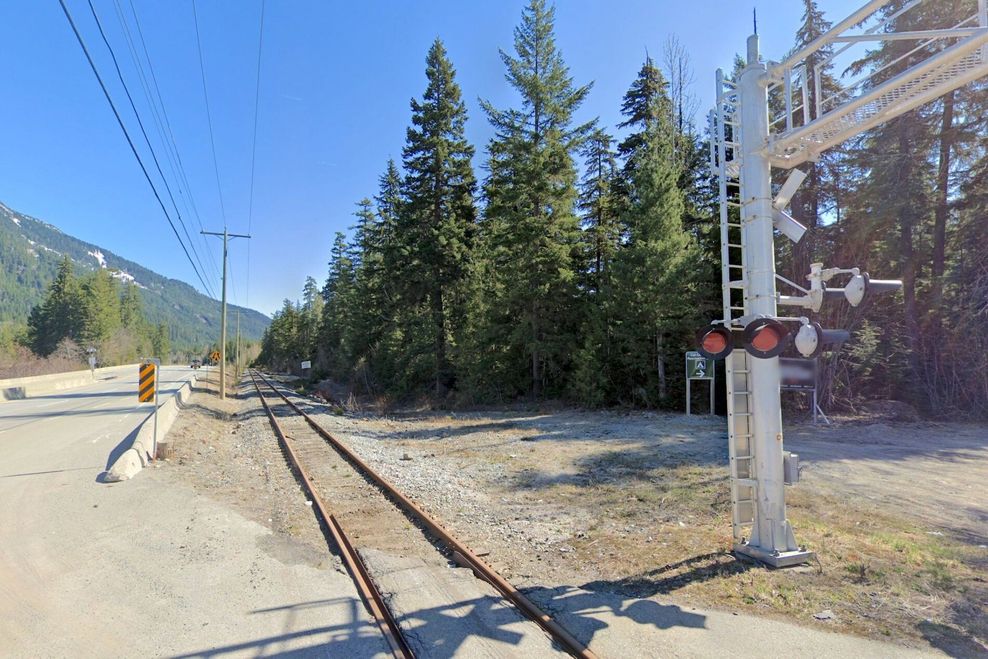
Written for Daily Hive Urbanized by Lee Haber, who is an urban and transportation planner and a board director of Mountain Valley Institute, which is a Vancouver-based non-profit society advocating for sustainable mobility infrastructure on BC’s South Coast.
The clock is running. Under the BC Rail Revitalization agreement, the provincial government holds an option until July 2026 to sell the rail corridor between Squamish and 100 Mile House back to CN Rail — for just one dollar.
Exercising that option would be the worst possible outcome for those who want to see this corridor preserved: once in CN’s hands, the line could be sold for scrap, and a rail right-of-way that took generations to build would be gone permanently.
But the option’s existence is itself a warning signal. If credible plans for revitalizing the corridor — through new passenger or freight rail — fail to materialize, a government currently experiencing large deficits will face growing pressure to offload its liability. Rail corridors, once scrapped, do not come back.
The goal, then, is not simply to stop a bad decision — it is to make a good decision so obvious that no government can ignore it. That means building the evidence, the political will, and the community support to make passenger rail on the Sea-to-Sky a credible near-term reality. The communities of this corridor — from North Vancouver to Squamish, Whistler, Pemberton, Lillooet, and well beyond — deserve nothing less.
- You might also like:
- CN Rail to end lease on Sea to Sky corridor railway through Whistler, opening door for rail public transit revival
- New calls for real public transit linking Vancouver, Squamish, and Whistler
- Passenger rail service from North Vancouver to Prince George being considered
- Opinion: BC Transit needs more funding for new interregional bus routes
- BC government study identifies potential West Coast Express extension and regional rail options between Metro Vancouver and the Fraser Valley
In July 2025, CN Rail announced its intention to discontinue its lease of the Squamish Subdivision. The line in question has a long and layered history. It once carried the Cariboo Prospector using Budd Rail Diesel Cars (RDC) — passenger trains that proved rail could work in this mountainous, technically demanding terrain. More recently, the Rocky Mountaineer has operated on the corridor, drawing tourists and generating real economic activity for communities along the route. But the corridor has never been restored for everyday, community-serving passenger rail service — despite more than two decades of advocacy, studies, and unfulfilled proposals.
CN’s withdrawal changes the calculus. For the first time in a long time, the future of this corridor is genuinely undetermined. That uncertainty is both a risk and an opening.
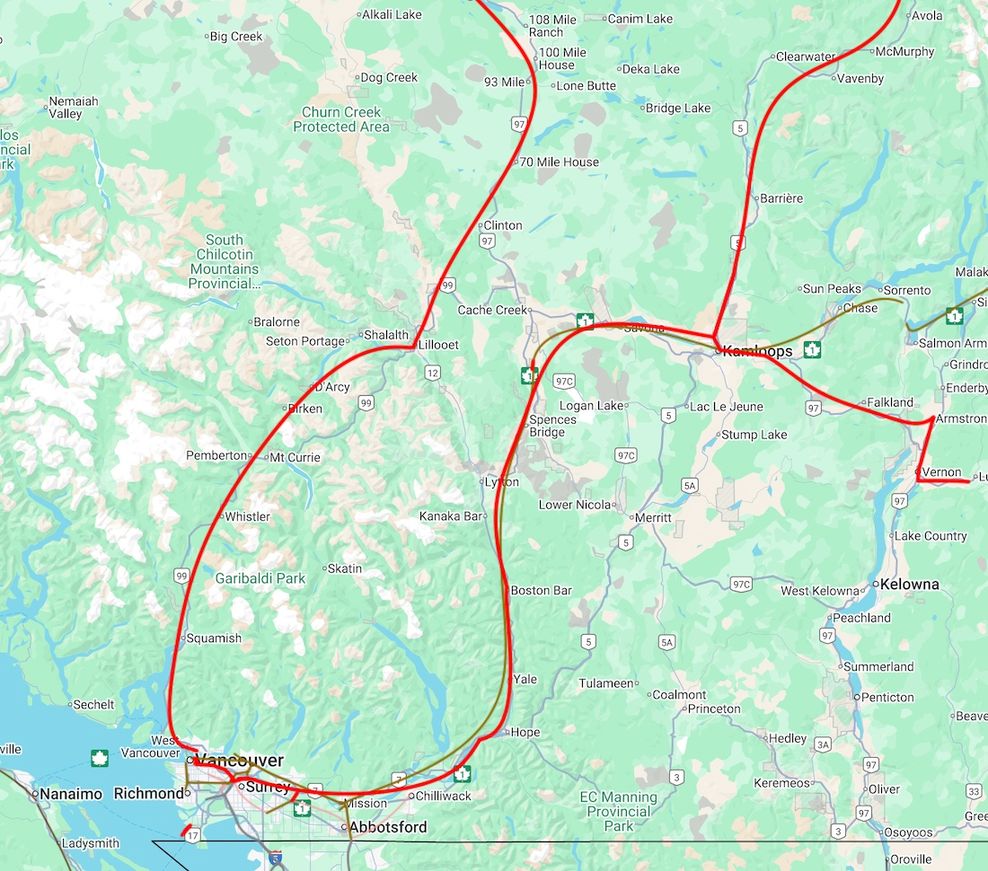
Map of CN Rail routes in southern B.C., including the BC Rail segment from North Vancouver to the Sea to Sky Corridor. (CN Rail)
An unprecedented show of political will
What is different this time is the politics.
In a January 2026 letter to Prime Minister Mark Carney and Premier David Eby, MLA Jeremy Valeriote and MP Patrick Weiler documented a level of political alignment that is genuinely rare in infrastructure advocacy: four MLAs and six Mayors gathered in September 2025 to discuss the corridor’s future. By November 2025, a follow-up virtual meeting drew more than 50 community leaders.
The breadth of signatories copied on that letter speaks for itself: Regional Districts from Squamish-Lillooet to Cariboo, more than a dozen municipalities from Lions Bay to Prince George, and dozens of First Nations — including the Lil’wat, Squamish, Tsal’alh, Tsleil-Waututh, and many others. This is cross-partisan, intergovernmental, and Indigenous-supported momentum of a kind that rarely materializes around a single piece of infrastructure.
Add to this the 2024 BC NDP election platform, which promised to develop a business plan for a commuter rail line linking Metro Vancouver, Squamish, Whistler, and Pemberton. Political commitments of that kind do not disappear; there is increasing pressure for action.
Perhaps the most striking thing about this corridor is the diversity of people who depend on it. This is not a commuter rail story, or a tourism story, or an Indigenous access story. It is all of those things at once.
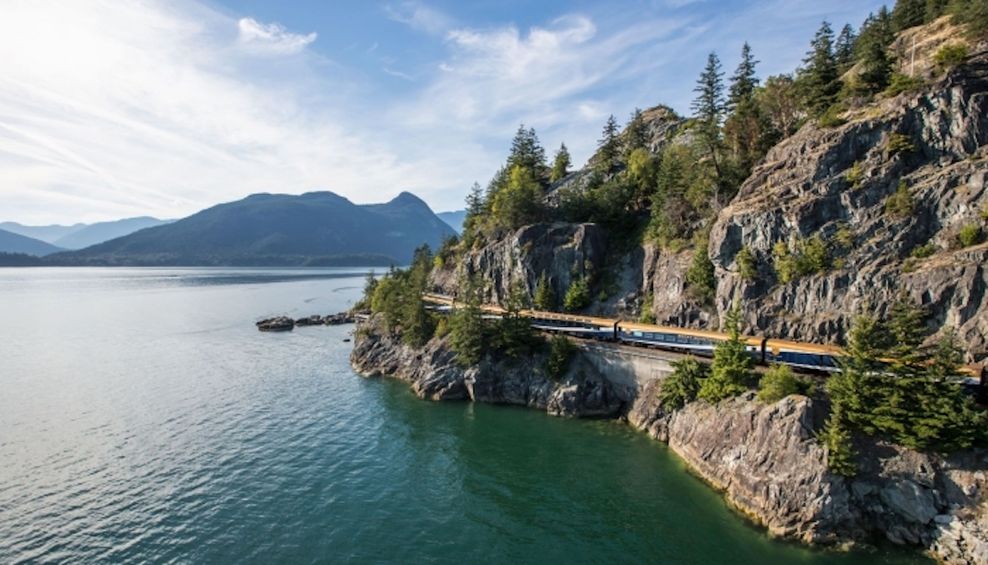
Rocky Mountaineer’s “Rainforest to Gold Rush” route running through the Sea to Sky Corridor. (Rocky Mountaineer)
A single-road region is a fragile region
Consider the Tsal’alh Nation, whose members currently rely on a high-rail bus along this corridor to travel to and from Lillooet — a service that is an essential lifeline for the community. Consider the Rocky Mountaineer, a world-class tourism product that generates significant revenue for towns along the line, and which would simply cease to exist if the tracks were ripped up. Consider the workers and young families being priced out of Metro Vancouver who are finding housing in Squamish and Pemberton, but for whom the daily commute on Highway 99 is an act of endurance.
And consider seniors and students without cars, employers struggling to recruit because staff cannot afford to live nearby, and the forestry, mining, and freight industries that could benefit from a revitalized corridor.
The case for this rail line is not narrow. It is as broad as the corridor itself.
Currently, Highway 99 is the Sea-to-Sky Corridor’s only surface transportation link. When it closes — due to a collision, a rockslide, severe weather, or any of the other disruptions that occur with troubling regularity — the region does not slow down. It shuts down. Completely.
This is a resilience failure with serious consequences: emergency services disrupted, workers unable to reach jobs, visitors stranded, and communities cut off from medical services and supplies. The vulnerability is only growing as the region’s population increases and Highway 99 carries more and more traffic.
Rail would not replace the highway. It would provide the redundancy the corridor desperately lacks — a parallel route that keeps communities connected when the road fails them.
This time is different — if we act
We will be the first to acknowledge that the Sea-to-Sky Corridor is not easy terrain for rail. The route is winding, with tight curves through challenging mountain topography. It requires real investment in infrastructure, signalling, stations, and rolling stock. These are not obstacles to be papered over — they are engineering realities that any credible proposal must grapple with honestly.
We know this because we’ve done the work. Our technical analysis of the Sea-to-Sky corridor, developed as part of our MVX Nexus regional rail vision for BC’s South Coast, demonstrated that passenger rail is viable here — not as a fantasy, but as a real and achievable outcome — if the right investments are made and the right approach is taken. The corridor can support modern rail service. The question has never really been whether it can be done. The question has always been whether there is sufficient will to do it.
Today, for the first time, the answer to that question is looking like yes. The political will is there. The corridor exists. The community support is overwhelming. What is needed now is the evidence base to translate that will into action: rigorous analysis of service options, travel times, costs, ridership, and subsidy requirements that gives decision- makers at every level of government something concrete to act on.
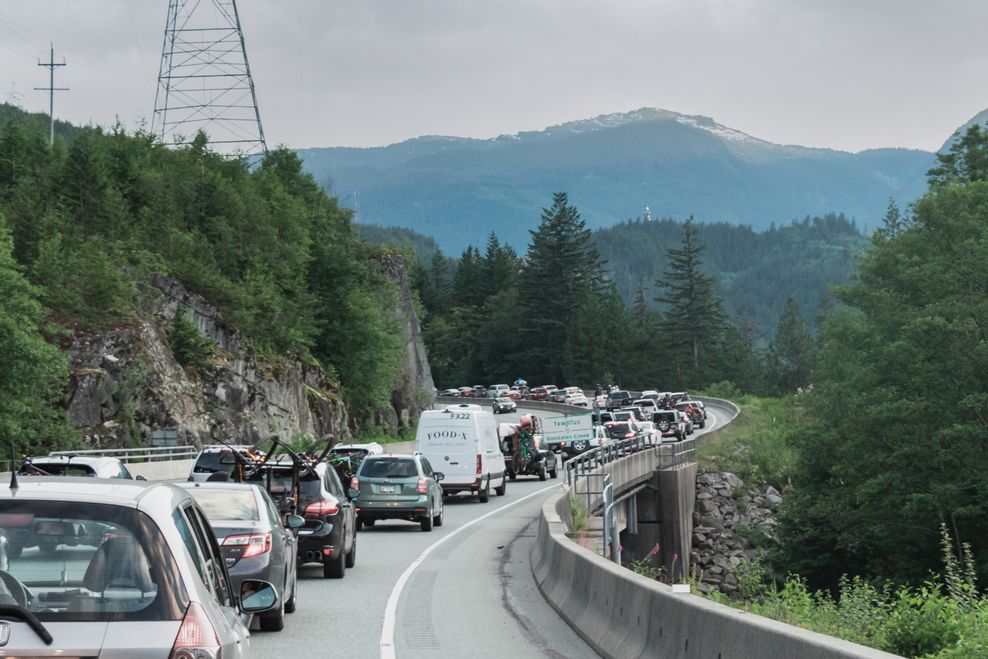
Traffic on the Sea to Sky Highway. (Margarita Young/Shutterstock)
Mountain Valley Institute is currently developing a near-term passenger rail feasibility study for the Sea-to-Sky Corridor — a decision-oriented analysis designed to give municipalities, First Nations, and senior governments the information they need to move from aspiration to implementation. We are seeking partners and supporters who share our conviction that this window must not be allowed to close.
The call from Valeriote and Weiler to the Prime Minister and Premier was direct: retain the corridor, identify funding, convene stakeholders, and establish a process to seize this once-in-a-generation opportunity. We echo that call. The tracks are still there. The corridor is still intact. The communities are ready.
The only question is whether British Columbia has the collective ambition to make it happen — before July 2026 makes the choice for us.
- You might also like:
- CN Rail to end lease on Sea to Sky corridor railway through Whistler, opening door for rail public transit revival
- New calls for real public transit linking Vancouver, Squamish, and Whistler
- Passenger rail service from North Vancouver to Prince George being considered
- Opinion: BC Transit needs more funding for new interregional bus routes
- BC government study identifies potential West Coast Express extension and regional rail options between Metro Vancouver and the Fraser Valley