


Opinion: Refusing change is a choice, and it's keeping the Downtown Eastside in crisis


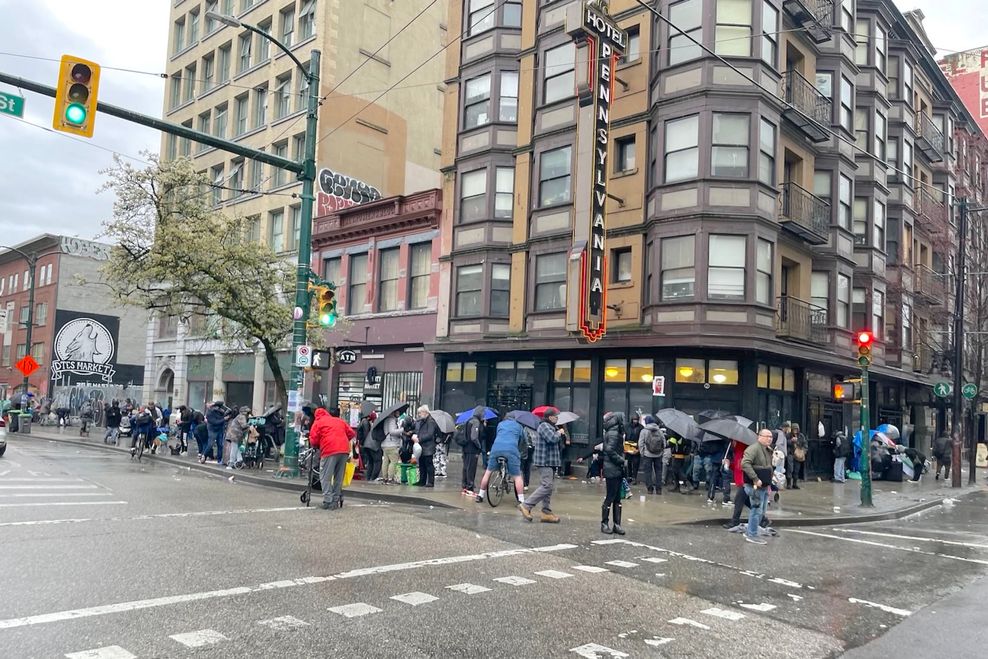
It is hard to imagine that exactly 100 years ago, the area now known as the Downtown Eastside was the vibrant core of the Metro Vancouver region. The Central Business District (CBD), the concentrated hub of shopping, dining, services, hotels, entertainment, and office workplaces, was situated on the easternmost end of the downtown Vancouver peninsula.
But over the subsequent decades, as growth and investment moved steadily westward on the peninsula, this first CBD was left behind. Even Vancouver City Hall moved out of the Downtown Eastside in the late 1920s due to the need for more space to serve a rapidly growing city. A new CBD in the west emerged, marked by landmark developments such as the 1912-built, Rattenbury-designed courthouse — now home to the Vancouver Art Gallery since 1983, often mistaken as having been built for the Gallery — along with successive towering generations of the Hotel Vancouver that rose nearby, the Marine Building office tower, the Canada Post processing centre, and the Hudson’s Bay department store building.
Modern office towers also began to rise in the new CBD, with one of the first most notable being One Bentall Centre in the 1960s. Pacific Centre mall and Harbour Centre — which had a Sears department store within a space occupied by a Simon Fraser University (SFU) satellite campus today — also opened in the 1970s.
Upon the onset of the Great Depression, waves of economic hardship, mass unemployment, and shifting urban priorities compressed the poorest residents into a shrinking pocket of aging buildings in the Downtown Eastside. What had once been a lively centre slowly hardened into a refuge of last resort, where cheap single-room occupancy (SRO) hotels (originally built for tourists and workers), eroding infrastructure, and the absence of broader affordable housing created a concentrated zone of poverty.
- You might also like:
- Proposed Downtown Eastside policy changes enable more market rental housing and social housing up to 32 storeys
- City of Vancouver to explore new density and uses to revive Railtown district, after public safety and business viability pleas from Aritzia, Herschel, and other employers
- Opinion: Vancouver is Canada's dumping ground for the homeless, and this needs to stop
- Opinion: Stop clinging to the past, Vancouver’s Chinatown is dead and needs revival
- Future of London Drugs at Woodward's uncertain due to crime
- Former TD Bank at Woodward's becomes new VPD community policing centre
- Vancouver emergency services strained by SRO and supportive housing calls: statistics
- Proposed Army & Navy Vancouver redevelopment grows taller with more rental housing and new hotel uses
- 'Granville Street is in full crisis': New pleas to immediately shut down all problematic SROs
By the late 20th century, a cascade of policy failures and social upheavals collided in this small area.
Mental health institutions — most infamously Riverview Hospital in Coquitlam — began to empty patients without the promised adequate community support, with many finding their way into the Downtown Eastside.
Rising real estate prices in the region began to displace more low-income tenants, and drug markets flourished in the vacuum left by neglect.
The disappearances of vulnerable women revealed just how invisible many residents were to the systems meant to protect them, while infectious disease spread rapidly among people sharing injection supplies, and fatal overdoses mounted. This led to the establishment of Insite, Vancouver’s very first legal supervised opioid consumption site in 2003 — and it worked as intended, reducing rates of infectious diseases substantially spread through unclean needles.
During this period, levels of government also began acquiring more aging buildings — many originally built a century earlier as tourist hotels or workers’ lodges — and converting them into deeply affordable housing for people experiencing homelessness as well as individuals with complex mental-health and substance-use challenges. This shift was accompanied by a rapid expansion of social and health services in the area, delivered both directly by government agencies and through a growing network of publicly funded non-profit organizations. The success of Insite also spurred the creation of additional supervised sites in the Downtown Eastside, though many in more recent years since the pandemic — amid “safe supply” and decriminalization policies — have emerged without clear safeguards or consistent operational standards for being a good neighbour.
A range of factors also contributed to the collapse of the Woodward’s department store chain in 1993, but the flagship location in the Downtown Eastside — one of the area’s very few remaining major business anchors — was undeniably affected by the district’s accelerating steep decline. By that point, the area that once served as Vancouver’s original CBD had long lost its prominence, overshadowed by the rise of the newer downtown core to the west and the growth of alternative shopping hubs throughout the region.
By the late 1990s and early 2000s, the escalating social challenges concentrated in the Downtown Eastside increasingly spilled into neighbouring historic Chinatown, further accelerating the deterioration of this unique cultural and retail district just to the south — leading to Chinatown’s current existential crisis. Gastown and other areas of the downtown Vancouver peninsula, including the contemporary CBD that exists today, are also directly feeling the Downtown Eastside’s gravitational pull now.
There were signs of optimism in the early 2010s that the long-standing downward trajectory might finally begin to shift. Redevelopment activity helped bring back a healthier mix of incomes and new businesses, most notably with the 2010 completion of the Woodward’s redevelopment by Westbank — a large mixed-use heritage complex combining strata market condominium ownership housing, social housing, a significant SFU satellite campus, and new businesses, particularly the anchor retailers of London Drugs and Nester’s Market.
Smaller initiatives also contributed to this sense of renewal, including the 2011 restoration by Reliance Properties of Burns Block, which renovated a deteriorating former SRO hotel into modest, functional market rental homes for working residents earning low to middle incomes. The opening of restaurants like PiDGiN in 2013 also drew widespread attention — and controversy — as activists in the neighbourhood viewed it as a symbol of gentrification pushing eastward.
However, by the mid-2010s, these positive gains were overtaken by a far more severe crisis. The rapid spread of fentanyl caused an unprecedented surge in overdoses and deaths, prompting the declaration of a public health emergency. The Downtown Eastside deteriorated at a pace not previously seen, as the toxic-drug supply overwhelmed the neighbourhood and erased much of the progress made just a few years earlier.
Then, the pandemic happened.
The impacts of the global health crisis fast-forwarded the Downtown Eastside’s pre-pandemic pace of decline by many years, perhaps even decades.
After 101 years, Army & Navy — the last long-standing major anchor business near the heart of the Downtown Eastside — permanently closed in May 2020. Success stories like the Burns Block quickly unraveled; intolerable conditions on its public sidewalk, storefront, and main entrances led to the closure of the once-popular Darby’s restaurant and pub on the ground floor, and more than half of the market rental homes inside the building sat empty a year into the pandemic. By 2021, the property was no longer financially viable, leading Reliance Properties to sell Burns Block to BC Housing for rapid conversion into supportive housing.
Even London Drugs and Nester’s Market have struggled since the pandemic from not only the overall further demise of the area, but also from exceedingly high levels of shoplifting and safety issues for staff. Earlier this year, London Drugs’ leadership told Daily Hive Urbanized that this location has lost more than $10 million since it opened in 2010 and has never turned an annual profit. Losses surged during the height of the pandemic, then eased slightly but have remained at elevated levels. The company made it clear that the store’s future — still operating largely out of goodwill — is far from certain.
TD Bank at Woodward’s closed in Summer 2024, due to repeat instances of vandalism and growing safety concerns for their staff. In July 2025, the former bank space reopened as the new Gastown-Hastings Crossing Community Policing Centre.
A decade of the poverty-only planning experiment
The original Downtown Eastside Plan (DEP), approved by the Vision Vancouver-governed City Council in 2014, was born out of good intentions — to protect low-income residents from displacement, preserve the neighbourhood’s “unique character,” and secure deeply affordable housing.
But DEP’s most defining stipulation — the rigid preservation of a 60-40 social housing-to market housing ratio, combined with building height restrictions and a near-freeze on private sector-spearheaded development — effectively locked the area into a state of structural stagnation. At the time of its consideration, the Vision Vancouver majority in City Council did not heed the warnings made by critics of the unintended major consequences of such stipulations and prescriptions over the long term.
Over 10 years later, by insisting that most new housing in the area be social housing, while blocking meaningful density and market investment, DEP unintentionally cemented the Downtown Eastside as an island of concentrated poverty. What was meant as an anti-gentrification strategy became, in practice, a poverty-entrenchment strategy.
DEP also leaned heavily on SRO preservation rather than SRO replacement, which meant thousands of Canada’s poorest residents remained stuck in substandard, unsafe, and deteriorating rooms within Vancouver’s oldest buildings dating back to the early 1900s.
Meanwhile, DEP’s extremely restrictive development conditions ensured that virtually no new private housing was built — only two projects under the inclusionary zoning rules succeeded over an entire decade, according to City of Vancouver staff.
Without a stream of new mixed-income residents, businesses had little incentive to open or stay; without residential density for independent working individuals, the streets remained under-activated and vulnerable to disorder; and without investment, the area’s physical environment decayed even further.
The result was a policy regime that kept wealth, stability, and opportunity out, while trapping existing residents in a shrinking ecosystem of failing buildings, street disorder, crime, and — for the lack of a better term — survival economies. DEP did not just fail to fix the Downtown Eastside — it unintentionally preserved exactly the conditions that made the neighbourhood so vulnerable in the first place.
After a decade of abysmal failure, the brand new strategy now outlined by City staff — to overhaul zoning, relax rigid one-for-one replacement requirements for SROs, incentivize mixed-income residential developments with social housing and market rental housing, enable buildings with greater density through added height, and strengthen tenant protections — may provoke fear and resistance among some poverty activists and groups. But these transformative changes represent precisely what the Downtown Eastside needs, not merely treating the symptoms of the issues — band-aids of gaping open wounds.
When you concentrate poverty, addiction, homelessness, and social vulnerability — as the Downtown Eastside has been for generations — you also concentrate the risks. When poverty is concentrated in one small area, the problems tend to pile up. Those districts and neighbourhoods often see more crime and fewer people able or willing to keep the community safe and orderly.
Catalyzing SRO replacement — the construction of brand new modern, safe, purpose-built social housing and supportive housing — is also essential to reducing homelessness. A significant share of visible homelessness in the Downtown Eastside arises not from the absence of housing, but from residents temporarily fleeing the deplorable conditions of their aging, poorly maintained SROs. These deteriorating buildings, combined with inconsistent operations by building operators and the challenges posed by disruptive and dangerous neighbours inside the building, often make life inside more chaotic and unsafe than life on the street. In other cases, individuals leave because they do not want to comply with the rules and expectations that come with living in a shared housing environment, including fire safety, drug use and dealing, hoarding, and other illicit and illegal activity.
This pattern became especially clear during stretches of extreme summer heat, when buildings lacking proper ventilation or cooling became unbearable. It was even more stark during the pandemic, when many residents left rather than follow the health safety protocols implemented by operators managing their buildings.
If the current approach was working, we wouldn’t see this crisis
Turning the Downtown Eastside’s dynamic around requires more than policing or other temporary services, although such services — contrary to militant anti-policing sentiments within certain groups — are still very much needed to handle immediate, day-to-day public safety issues when no real lasting solutions are being implemented.
Beyond the day-to-day measures, it requires an infusion of stability, diversity, and economic energy — and that is precisely what mixed-income housing and redevelopment brings.
Social housing and other deeply affordable housing does not automatically introduce or increase crime, of course. On the contrary, well-managed affordable housing developments and mixed-income redevelopment can coincide with declining rates in crime, reductions in assaults and robberies, improved property values, and greater neighbourhood stability.
Let’s put an emphasis on the importance of “well-managed.”
Since the pandemic, there has been an attempt to establish supportive housing and other services well outside of the realm of the Downtown Eastside. This was the right move, but the execution has been appalling.
For years, governments, the local health authority, and non-profit operators have had every opportunity to show that supportive housing and services for people with complex needs can be run safely, responsibly, and in ways that respond quickly and meaningfully to concerns raised by neighbours and local businesses. Supportive housing should also be actually “supportive,” with ample services provided.
Instead, what residents and businesses have too often received from governments, the health authority, non-profit operators, and activists is a form of gaslighting — reassurances that contradict their lived experience, even as issues like crime, safety risks, vandalism, public disorder, and unmanaged garbage continue to escalate around them.
The previous controversial overdose prevention site (OPS) on the edge of Yaletown and the SROs along the Granville Strip — especially the former tourist hotels that were hastily purchased during the pandemic and rapidly converted into supportive housing — have become cautionary tales.
This past summer, for example, the nightclub owner on the ground level of the Luugat — the supportive housing uses in the former Howard Johnson hotel in the Granville Entertainment District — shared his business has seen at least 200 floods, ever since the hotel guest room levels above his establishment were converted into supportive housing five years ago. Such challenging operating conditions never existed before the property’s conversion by government. Moreover, this property sees very high frequencies of police calls and fire responses, with the government allegedly turning a blind eye to challenges until recently — the Luugat is now set to permanently close by early Summer 2026. Local residents and businesses have blamed the Granville Strip’s rapid decline to these SROs and supportive housing buildings.
These sites are regularly cited by local residents and businesses as examples of extremely poor oversight, weak accountability, and operational models that simply were not designed to handle the level of need and complexity placed on them. It is no surprise, then, that proposals for such new facilities in neighbourhoods like Kitsilano and in cities like Richmond now meet intense resistance.
Frankly, governments and non-profit operators have only themselves to blame for the cancellation of the Kitsilano and Richmond projects, as their track record elsewhere at problematic sites has undermined public trust. For governments, specifically, it shows they are willing to break their social contract with citizens whenever it is convenient and politically expedient.
If mixed-income neighbourhoods are truly the goal — and they should be — then governments and non-profit operators must take a hard, honest, and non-ideological look at their operating models and make the major, overdue shifts needed to fix them.
Without restoring confidence in their ability to manage deeply affordable housing and services responsibly, attempts to build healthier, more diverse communities — both inside the Downtown Eastside and elsewhere in the city and region — will continue to face fierce pushback by existing residents and businesses. This also includes addressing encampments, open drug use, and other public disorder that may be related to such facilities being in close proximity.
This means that even future mixed-use developments in the Downtown Eastside, which rely on a balance of market housing and businesses to succeed, will struggle so long as these underlying operating failures remain unaddressed. And it also means that efforts to distribute deeply affordable housing and supportive services in other areas — instead of isolating nearly all of them in the Downtown Eastside — will keep encountering intense opposition in other neighbourhoods. Until these issues are fixed, the very communities we need to strengthen and diversify will continue to resist the change required to make progress.
Perhaps no recent purpose-built market housing project captures the stark realities of the Downtown Eastside more vividly than Sequel 138 — the six-storey mixed-use building completed in 2014 on East Hastings Street, just west of Main Street. From the moment it was proposed, it sparked intense controversy, not only for introducing strata market ownership condominiums into the very epicentre of the Downtown Eastside’s struggles, but also for replacing the historic Pantages Theatre, a neglected 1907-built landmark many hoped to preserve.
Sequel 138 contains 79 strata condominium homes, 18 social housing units, and ground-level retail/restaurant spaces, yet its entrances and storefronts are routinely obstructed by public disorder, open drug use, and the same street-level challenges that define the immediate area. The fact that the project was built at all demonstrates that private developers can take on risk in the Downtown Eastside — but its ongoing struggles underscore a deeper truth: these projects need to happen at scale, and cannot succeed in a sea of dysfunction.
Once these underlying issues are actually resolved, perhaps such projects in areas like Kitsilano and Richmond will not see opposition.
Within the Downtown Eastside, after the issues are resolved, mixed-income developments can bring economic investment, community services, new businesses, and more “eyes on the street” — all of which help deter crime (Crime Prevention Through Environmental Design principles), improve public safety, and foster a sense of normalcy and civic pride. It would help support the new hotel and other businesses at the future Army & Navy mixed-use residential and commercial redevelopment, and prevent the closure of the two major anchor retailers at Woodward’s, for instance.
Keeping the neighbourhood locked into cycles of neglect — old dilapidated SROs for the poor, broken promises, and limited private investment — ensures the social and economic decay is further entrenched. Opponents to real change in the Downtown Eastside will argue that mixing incomes and introducing market-rate housing will displace existing vulnerable residents, erode the heritage of the neighbourhood, and lead to gentrification. But doing nothing, more of the same, or continuing half-measures condemns the Downtown Eastside to stagnation, decay, and endless cycles of harm.
To expect a different outcome by continuing more of the same policies and strategies is the textbook definition of insanity.
Opposing change protects non-profit organizations, not people in need
The Downtown Eastside is not the kind of area that can be saved by merely tinkering. At this point, every tool in the toolbox needs to be used. Not doing so is akin to tying one hand behind a surgeon’s back while asking them to perform a life-saving operation that requires major intervention.
What matters more — protecting the process, or delivering meaningful, lasting results?
And this raises a particularly difficult but unavoidable question: why are so many advocates and organizations clinging so fiercely to an approach that has allowed poverty and disorder to deepen?
It is hard to ignore the reality that a whole ecosystem of non-profit organizations and advocacy groups — many supported by significant public funding — has grown around the Downtown Eastside’s persistent suffering. This is an ecosystem that depends, at least indirectly, on the neighbourhood remaining poor, destabilized, and in crisis.
It should also be emphasized that many operating in the area also have the best of intentions and want to see real meaningful change, too.
But for others, when the status quo becomes someone’s sole livelihood, defending that status quo can begin to look like moral conviction even when the results on the ground show continued human misery. If the neighbourhood truly stabilized — if it diversified economically, underwent real redevelopment, became mixed-income and functional, and more residents permanently recovered to become independent, capable, contributing members of society — many organizations would inevitably become less central to the landscape. That does not necessarily mean ill intent — but it does mean strong structural incentives to oppose transformative change.
This is why some of the pushback against mixed-income redevelopment, private investment, and organizational audits must be understood not only as ideological resistance, but as a form of personal and institutional self-preservation. Real revitalization threatens the continued existence of an entire industry built around managing, studying, and serving entrenched poverty — an industry that benefits from permanent crisis far more than from genuine recovery.
Just over a decade ago, the Vancouver Sun reported that about $360 million per year or an average of more than $1 million per day are spent on social services and affordable housing in the Downtown Eastside, with much of this going to the non-profit organizations and their staff and contractors. More recent estimates suggest this could now be exponentially more, perhaps somewhere in the range of $6 million to $14 million per day.
Is the resistance to meaningful redevelopment really about protecting vulnerable residents, or about protecting organizational relevance?
- You might also like:
- Proposed Downtown Eastside policy changes enable more market rental housing and social housing up to 32 storeys
- City of Vancouver to explore new density and uses to revive Railtown district, after public safety and business viability pleas from Aritzia, Herschel, and other employers
- Opinion: Vancouver is Canada's dumping ground for the homeless, and this needs to stop
- Opinion: Stop clinging to the past, Vancouver’s Chinatown is dead and needs revival
- Future of London Drugs at Woodward's uncertain due to crime
- Former TD Bank at Woodward's becomes new VPD community policing centre
- Vancouver emergency services strained by SRO and supportive housing calls: statistics
- Proposed Army & Navy Vancouver redevelopment grows taller with more rental housing and new hotel uses
- 'Granville Street is in full crisis': New pleas to immediately shut down all problematic SROs