


Opinion: What's red and takes 1,000 days to create? Vancouver bus lanes with paint and signs, apparently


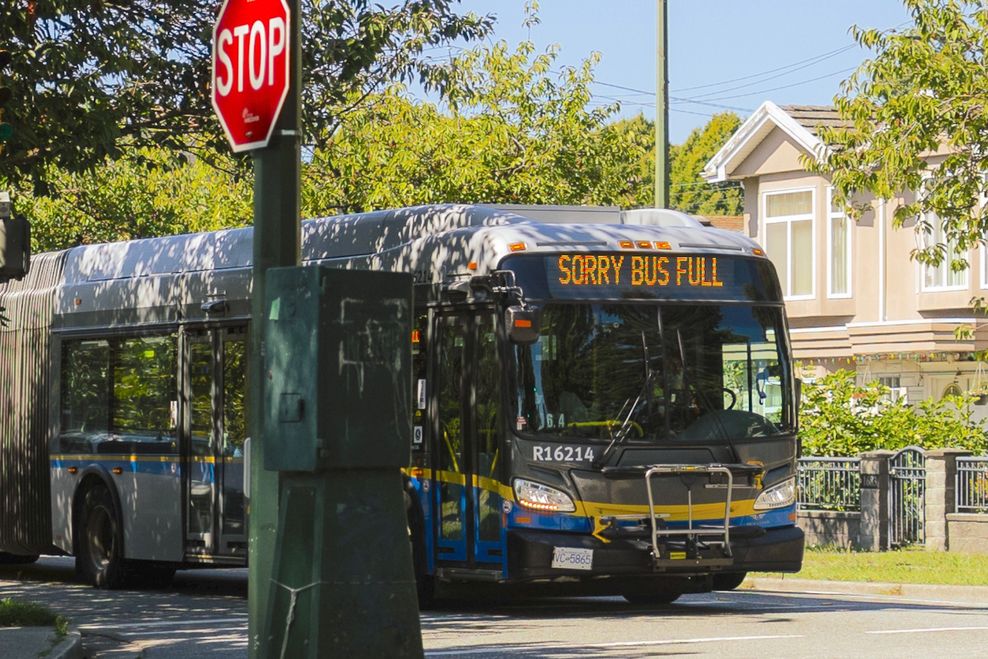
Written for Daily Hive Urbanized by Michael Hall, the Lead for Government Relations at Movement: Metro Vancouver Transit Riders.
Vancouver City Council voted unanimously in both 2023 and 2024 to speed up buses on major corridors. Why, then, have there been next to no improvements almost 1,000 days later?
In October 2023, Vancouver City Council voted unanimously in favour of a member motion by city councillor Sarah Kirby-Yung to add bus priority measures on major bus corridors in the city, including Hastings Street, Kingsway, 49th Avenue, and Granville Street. The goal was to improve travel times by at least 10 per cent by 2026. This motion passed over 800 days ago.
With no progress over the subsequent 10 months, in July 2024, City Council again voted unanimously in favour of a member motion by then-city councillor Christine Boyle to add corridors to the list of projects, add guidelines on the level of bus priority, and impose conditions on the pace of the work: “achieving four completed corridors by 2026, at a rate of at least two corridors per year.”
These extra routes included Broadway, King Edward, West 4th Avenue, and Southwest Marine Drive, as well as the corridor between downtown Vancouver and the Ironworkers Memorial Bridge via Powell and Cordova streets. This second motion passed 537 days ago.
- You might also like:
- Main Street and Kingsway buses in Vancouver get priority as new bus lanes and stop changes roll out
- Opinion: If TransLink builds Bus Rapid Transit, it must be done right
- Opinion: This busy Metro Vancouver bus route is a masterclass in how to put public transit last
- About 90% of TransLink's first two Bus Rapid Transit lines will have bus-only lanes
- TransLink proposes permanently relocating 99 B-Line bus stops a few blocks
- New looping TransLink bus route on Stanley Park Drive could launch in 2027
Now, more than a year removed from the second motion by Boyle and nearing 1,000 days from the original 2023 motion, where do things stand?
Community engagement has been completed for the Granville Street corridor, and plans for Kingsway have been released, showing three per cent in travel time savings.
Actual bus priority? Almost none to be seen.
The City of Vancouver has been slow-walking this work in extraordinary fashion, taking more than two years to paint some pavement red and add some additional parking restrictions to street signs.
But “slow-walking” is generous. Ever since the original 2023 motion, a few much more significant projects have made great leaps forward, while buses remained stuck in traffic. The new PNE amphitheatre broke ground and is now just months away from reaching completion. The tunnel boring machines responsible for SkyTrain’s Millennium Line’s Broadway extension completed their journeys, and station construction progress is now approaching an advanced stage.
Bus lanes don’t need to take this long
In stark contrast, the City of Toronto put in emergency bus lanes in just four days when issues with their busiest streetcar route necessitated deploying buses. It was not perfect, but it shortened travel times significantly.
In another recent situation — though not as rushed — Toronto added dedicated bus lanes on Dufferin Street, a four-lane road not dissimilar to 49th Avenue’s urban environment, in just three months. City officials recognized that the FIFA World Cup presented a good opportunity to improve mobility.
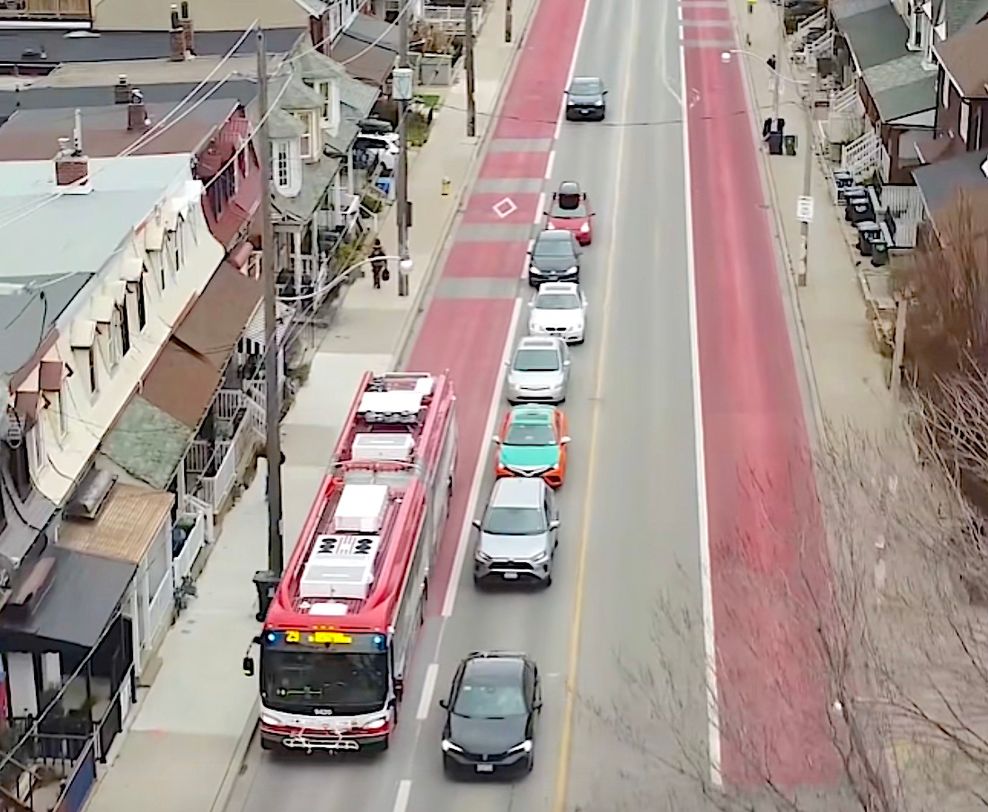
Bus lanes on Dufferin Street in Toronto were implemented in three months following approval. The bus lanes were implemented into a four-lane street by removing curbside street parking. Emulating this on Vancouver streets like 49th Avenue or King Edward Avenue would improve two major TransLink bus routes (No. 49 UBC/Metrotown and No. 25 UBC/Brentwood). (Kevin Rupasinghe/submitted)
So, will Vancouver do the same? In an internal memo by City of Vancouver staff, plans to improve bus speed and reliability on Hastings Street include just 1.7 km of bus lanes for the buses that will be shuttling thousands of fans daily to and from the FIFA World Cup Fan Festival at the PNE fairgrounds. Any further work on the Hastings Street corridor not near Hastings Park — public engagement and/or implementation — is not scheduled to occur until 2027, at least 1,200 days after the original motion.
If Toronto can do it, what is holding Vancouver back? Often, with projects like these, street parking acts as a roadblock. In a growing city, businesses — and therefore politicians — continue to rely on the finite capacity of curbside parking to sustain, nay, grow businesses. Yet curbside space has never increased; the amount of space available for patrons to park their cars has remained unchanged since the road was first built.
Or perhaps it is City staff capacity that is holding these projects back. It cannot be capital funding — TransLink is providing all of that.
In response to a motion raised at a closed Mayors’ Council meeting on Oct. 25, 2023, TransLink’s 2024 Investment Plan included an expansion of the Bus Speed and Reliability program to add “corridor funding” for high-delay routes. A total of $17 million was allocated to implementing strong bus priority on Hastings Street, Kingsway, 49th Avenue, and Granville Street, with Marine Drive later added. The justification was clear: resolving delays on these corridors would save approximately $2 million per year in operating costs for TransLink, delivering a strong return on investment.
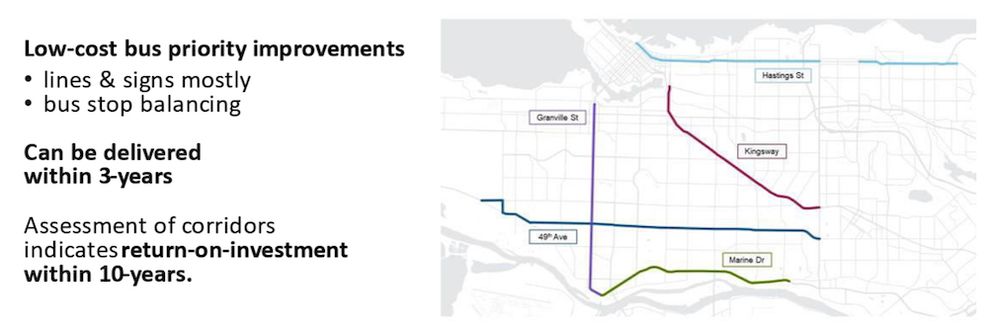
TransLink admits in 2024 that projects to improve high-delay bus corridors will mostly be “lines and signs,” yet even so, there are no improvements to be seen in January 2026. The goal to “deliver within 3-years” lacked ambition from the very beginning. (TransLink)
Whatever the cause, it is not a legitimate one. Cities around the world are recognizing what it takes to improve urban mobility — and they are acting on it: Seattle; San Francisco; New York City; Los Angeles; Saskatoon; London (Ontario); and Madison (Wisconsin). Even within our own region, jurisdictions like Surrey and North Vancouver City are delivering truly excellent bus lanes.
The lack of investment in South Vancouver remains evident in the workplan for bus priority corridors. Not only does the No. 49 UBC/Metrotown — the busiest local (non-express) bus route in the region – have virtually no bus priority, but the planned improvements for the 49th Avenue and Marine Drive corridors extend well beyond the route itself and sit at the very end of the queue for current bus priority projects, according to the City’s website.
To make matters worse, last fall the timelines for these corridors were quietly shifted from “in 2026” to an unspecified date in the future.
What needs to change
Vancouver’s municipal government needs to show that it actually has the organizational capacity to undertake simple projects like bus lanes.
Putting paint on the ground and changing signs to drastically improve urban mobility is one of the most basic functions that a municipality should be able to accomplish.
And yet, roughly 27 months after that initial City Council vote on the motion, there is nothing. This reflects extremely poorly on the City, showing that it just cannot get the basics done.
To see immediate results, the City could restrict curbside parking from 7 a.m. to 7 p.m. across large swaths of the city — specifically in areas where ample curbside or off-street parking exists nearby, and where bus riders make up a significant share of overall road users. These conditions exist in many places.
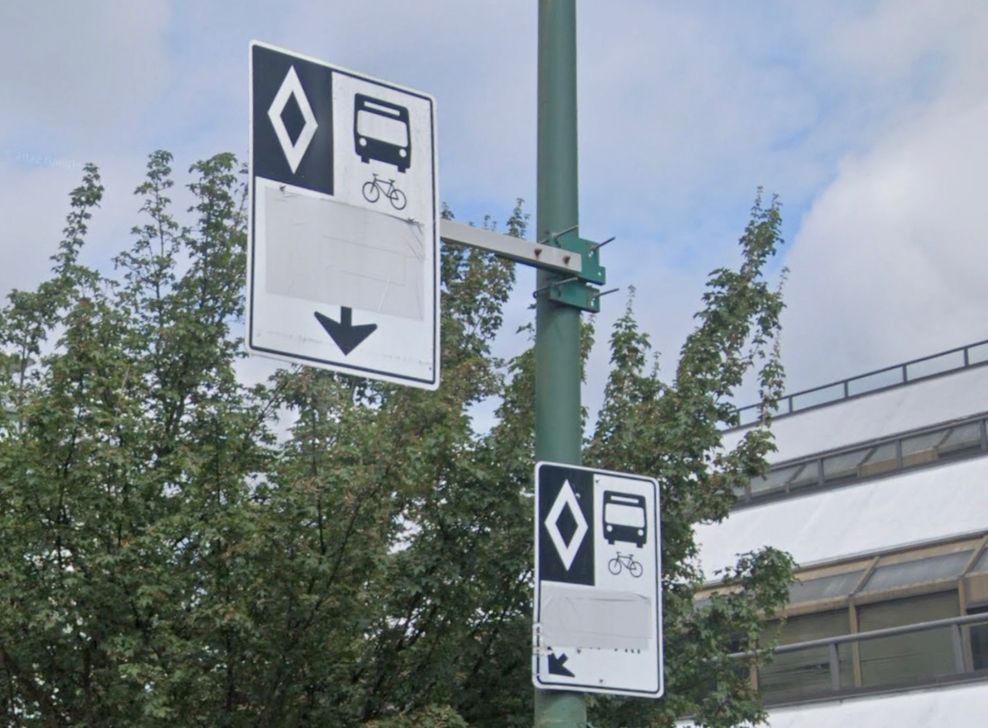
Bus lane signs can easily be altered (improved) by simply adding white stickers or tape to cover up the text outlining the hours. A sign can be changed from “3-7 PM Mon-Fri” to an all-day bus lane in a matter of seconds, with no replacement or engineering work required. The same can be done for associated street-level parking restriction signage. (Google Maps)
Where parking restrictions or bus lanes already exist, their hours could be extended through something as simple as applying white stickers to existing signage — a method the City has already used to adjust bus lane hours. In fact, the only notable bus-priority improvement in recent years came this way, when bus lane hours were extended on Broadway to include the westbound lane during the afternoon rush hour. If you can apply a sticker, you can improve a bus lane.
More fundamentally, City leadership needs a frank reckoning with how it prioritizes street space. If it wishes to perpetuate time- and money-wasting gridlock — and continue encouraging the most expensive and least efficient mode of transportation, personal vehicles — then it should keep slow-walking the bus lanes it has now promised twice.
If, instead, leadership genuinely wants to move people more freely and affordably, it already knows where to put the stickers and the paint.
- You might also like:
- Main Street and Kingsway buses in Vancouver get priority as new bus lanes and stop changes roll out
- Opinion: If TransLink builds Bus Rapid Transit, it must be done right
- Opinion: This busy Metro Vancouver bus route is a masterclass in how to put public transit last
- About 90% of TransLink's first two Bus Rapid Transit lines will have bus-only lanes
- TransLink proposes permanently relocating 99 B-Line bus stops a few blocks
- New looping TransLink bus route on Stanley Park Drive could launch in 2027