


Vancouver housing market 'uncertain' despite record housing completions in 2025


Vancouver’s housing market softened in 2025 with a record number of housing completions, but a recent report warns that “this short‑term surplus hides emerging imbalances.”
The Canada Mortgage and Housing Corporation (CMHC) released its Spring 2026 housing supply report today, looking at the housing market in 2025.
“We experienced a surge of housing completions — both in condominium and rental space — in the past year … and we expect this to continue for the next couple of years,” Shiva Moshtari-Doust, CMHC’s lead economist for B.C., told Daily Hive.
In 2025, there were 30,855 housing completions in Metro Vancouver, according to data that CMHC provided to Daily Hive on housing completions from 1990 to 2025. This is the highest number recorded in that time frame.
This is over 5,000 more than 2024 (25,614 completions) and over 10,000 more than 2023 (20,797 completions).
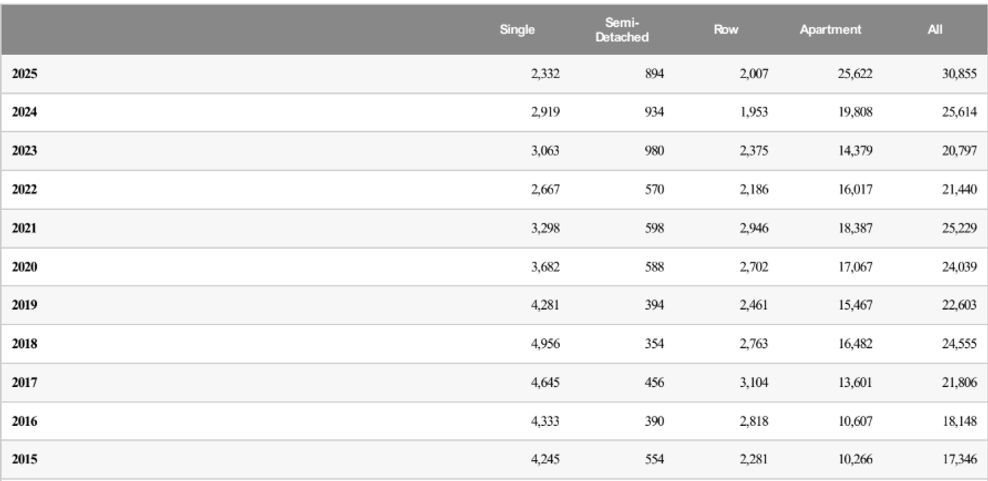
Historical completions by dwelling type. CMHC/supplied
But she warned that the housing “pipeline is thinning” and that “two, three years down the road, we might see a challenge.”
Housing starts peaked in 2023, at 33,244 (up from 25,983 in 2022).
In 2024, there were 28,112 housing starts, and 27,185 last year.
Moshtari-Doust attributes the recent slowdown in housing starts to low presales in the condo market (where the vast majority of housing starts have occurred), slower population growth, and a softer rental market for new builds that challenges newer rental projects.
Further, there’s a lot of uncertainty in the market due to the U.S.-Canada trade war. And while interest rates are low now (making the cost of borrowing cheap), CMHC is also forecasting that they will increase in the next year or two, which could make borrowing more expensive.
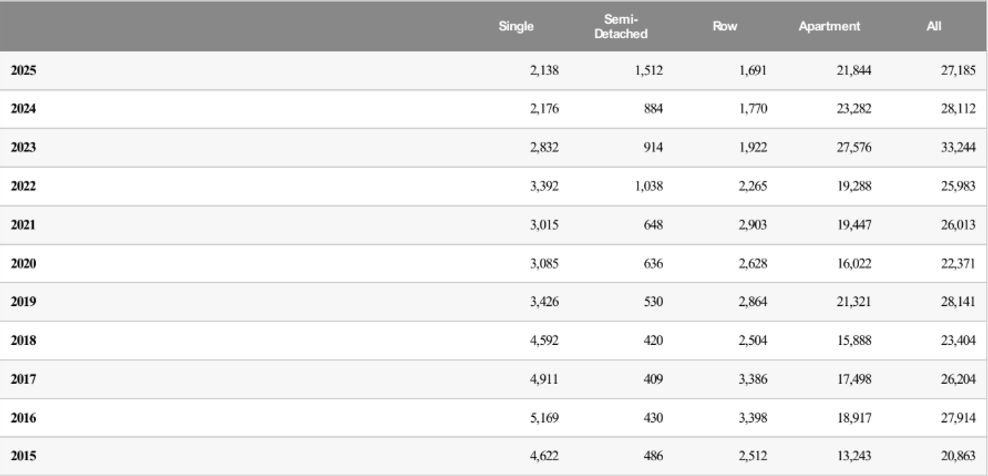
Historical starts by dwelling type. (CMHC/supplied)
“So, a lot of investors are waiting on the sidelines, and pre-sales are basically really collapsing. And that’s why, mostly condominium projects are either delayed, shelved or cancelled. Or some of them are also pivoting to rental projects as a result,” she said.
However, she added that CMHC expects to see some pick-up in the market in 2026. Since interest rates are expected to increase in the next year or two, buyers might be incentivized to purchase now while rates are still low.
“It wouldn’t be a crazy increase. It would be moderate, picking up before it probably stabilized again.”
‘Over-supply’ in the market
Right now, there’s a bit of an “over-supply” in the market, which Moshtari-Doust said will continue for the next couple of years.
But without the needed housing starts, the housing market might not be able to serve the demand if it returns.
“Because construction timelines span multiple years, this mismatch between the short- and long-term picture invites caution in interpreting today’s eased market signals as signs to slow down construction,” reads the CMHC report.
A report from the B.C. Real Estate Association (BCREA) published earlier this year had a similar warning, stating that record-high unsold housing inventory, weak construction activity, and stalled pre-sales could set the stage for another sharp deterioration in affordability later this decade if corrective action is not taken now.
BCREA said that B.C. home prices are at risk of jumping by 27 per cent by 2032.
With files from Kenneth Chan