


How at-risk your home is ahead of another potentially bad B.C. wildfire season


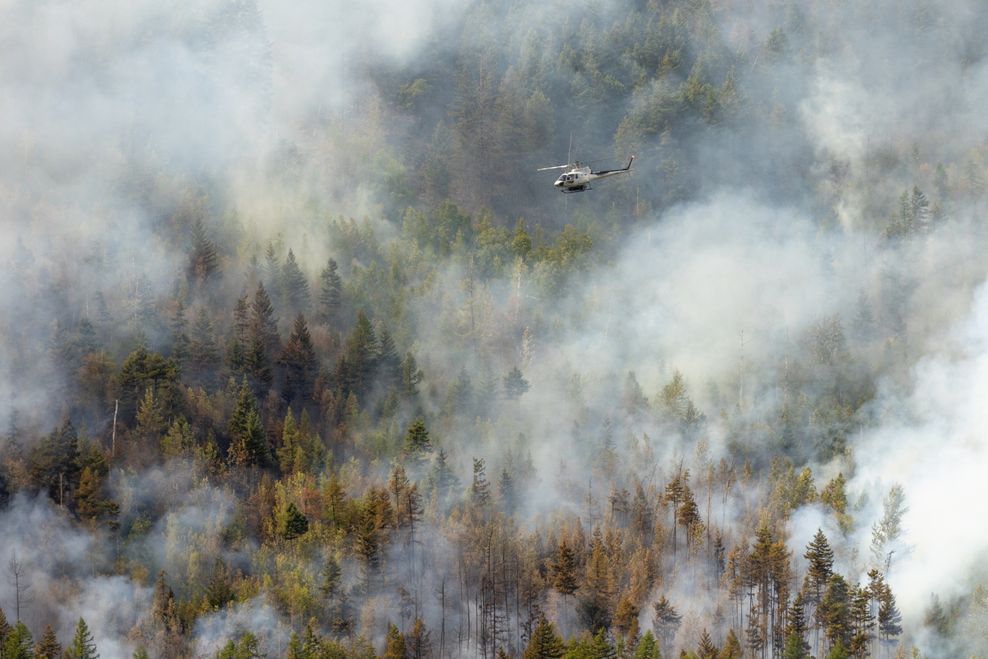
With experts concerned that 2026 might be another bad year for wildfires in B.C., you might be wondering how at-risk your home is.
Vancouver-based AISIX Solutions recently launched WildfireScore, a tool that generates a property-level wildfire risk score for Canadian addresses.
You go to the website, type in your address, and the tool generates your score on a risk level of one to five, one being the least at risk and five being the most at risk.
This is the first iteration of the product, and AISIX Solutions plans to keep adding information, like a short-term fire forecast, fire alerts, and connecting people with wildfire mitigation companies.
Gioachino Roberti, the CEO of AISIX Solutions, said he wanted to create this tool because he was surprised at how little access Canadians had to natural hazard or risk information, compared to places like the U.S. or Europe.
“And so we wanted to give the opportunity to everybody to start to understand their wildfire [risk],” he said.
Are we in for another bad wildfire season?
Currently, there are several signs that B.C. could experience a lot of wildfires this summer.
Much of Canada and B.C. is experiencing ongoing dryness and drought, seasonal fire forecasts are predicting a hot and dry summer, and it is expected to be an El Niño this summer (which generally results in hot and dry summers).
Environment and Climate Change Canada has also predicted that 2026 will be among the hottest years on record, with the global mean temperature predicted to fall between 1.35 and 1.53 higher than pre-industrial levels.
B.C. is no stranger to wildfires, with the past few years breaking records. Nearly 900,000 hectares burned in 2025, nearly 1.1 million hectares in 2024, and a whopping 2.8 million hectares in 2023 — all above the 10-year average.
How does the score work?
The WildfireScore is run on the same modelling framework that the Canadian Forest Service uses. It uses machine learning and IPCC climate projections to show risk today and under 2050 warming scenarios.
Roberti said they simulated about 30,000 fire seasons (which is about 30 million fires at a country scale).
They considered the probability of a fire igniting, fuel maps (different trees burn in different ways), topography (fire spreads faster on steeper slopes), and temperature, precipitation, humidity, and wind.
Once people get their score, Roberti said, they can understand how much at risk their home is to wildfires.
“If it’s a one, it’s probably fine, but if it’s a three, maybe worth it to start to look at ways in which they might be more resilient to fire.”
Roberti said people can look at programs like FireSmart B.C., changing their roof to a fire-resistant material, or clearing bushes around the property.
“The first step towards doing anything is knowledge. So if you don’t have knowledge, you don’t know.”