


Opinion: Chasing another store to fill the big void at Woodward's misses the point of why London Drugs left


Written for Daily Hive Urbanized by Sarah Beley, the executive director of Working Gear Clothing Society.
When London Drugs closed its Woodward’s location, many people framed it as the loss of a convenient place to shop.
For those of us who work nearby, it felt like confirmation of something we’ve quietly known for years.
I work at Working Gear Clothing Society, a non-profit organization that provides free clothing and job-readiness support to people trying to re-enter the workforce. Our office sits near the intersection of Main Street and East Hastings Street — a few blocks from the Woodward’s complex — and I’m on these streets every day.
Recent suggestions to simply add another retailer aren’t revitalization, they’re setting the next business up to fail.
This isn’t a retail problem.
It’s a stability problem.
- You might also like:
- Downtown Eastside community wants more retail after London Drugs closure, not police
- Vancouver Police opening major patrol operations hub at Woodward's, while exploring training academy at former London Drugs space
- 'This area will not be safe': Vancouver residents decry lack of government action after London Drugs closure
- London Drugs at Woodward's to permanently close due to 'persistent safety incidents'
- Opinion: Refusing change is a choice, and it's keeping the Downtown Eastside in crisis
“We need to be honest about what the environment looks like”
In five years in our building alone, six tenants have moved out, and none have moved in to replace them.
We’ve lost a coffee shop, a dollar store, an art gallery, a travel office, independent artists, and even a public defender’s office. When everyday retail, discount retail, creative businesses, and essential services all struggle under the same conditions, the issue isn’t the tenant; it’s the environment.
And we need to be honest about what that environment looks like.
Staff and volunteers regularly witness overdoses, deaths, and assaults. I’ve been accidentally maced twice. Volunteers have been randomly assaulted while simply walking to and from our office. We’ve seen violent attacks and overdoses that ended with the coroner. Even when you aren’t the victim, it takes a toll on the people working here every day.
So, when people say the answer is just replacing London Drugs with another store, that new retail will “revitalize” the neighbourhood, it doesn’t reflect what businesses actually face here.
That approach works in neighbourhoods where stores can operate safely and predictably. Those conditions don’t exist here.
“Retail doesn’t create stability; stability creates retail”
London Drugs didn’t close because the community didn’t need it. It closed because of theft, safety concerns, and operating losses made it financially unsustainable. If a national chain with scale and security budgets couldn’t survive, how is a small independent shop supposed to?
Recently, dollar stores have been suggested as a practical replacement for the space. But that’s neither realistic nor responsible.
There’s also an irony in what we’re proposing. Dollar stores, often criticized for low wages, understaffing, and higher per-unit prices in low-income areas, are somehow framed as the solution. These retailers operate on razor-thin margins and depend on minimal losses to survive. Even small increases in theft or security costs can wipe out profit entirely. In an environment like this, many wouldn’t last long. A discount chain isn’t revitalization. It’s another fragile tenant set up to fail.
It’s also not fair to keep asking small businesses to carry the burden of problems we haven’t addressed. We say we want cafés and neighbourhood shops, then expect them to absorb constant theft and safety risks while barely breaking even. When they close, we act surprised.
Retail doesn’t create stability. Stability creates retail.
The need for a tenant to provide the area with consistent foot traffic
What this area needs first is a reliable anchor.
The idea of a police training academy at the former London Drugs site has been floated in City discussions, though nothing is confirmed with the Justice Institute of British Columbia. Still, an institutional tenant, whether a school or another public service, would bring students, instructors, and staff every day. That means consistent foot traffic, predictable activity, and real support for nearby businesses.
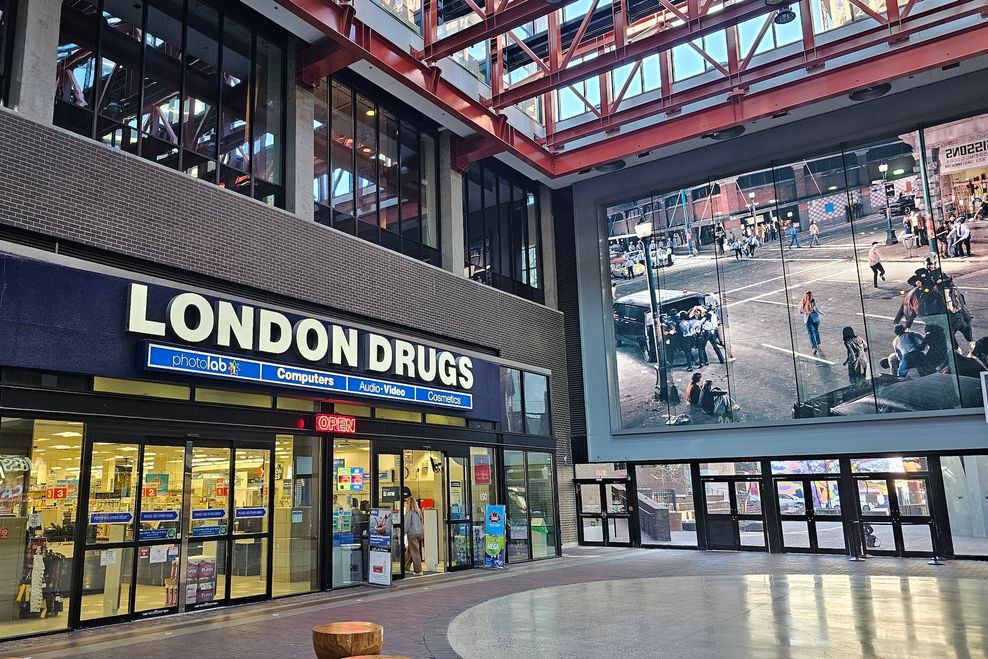
Inside the Woodward’s complex hangs Abbott & Cordova by Stan Douglas, depicting the Gastown Riot, a moment many Vancouverites associate with police overreach and broken trust. Some see irony in training future officers nearby. I see accountability. Learning to work in vulnerable communities, under a reminder of what happens when policing goes wrong, could help shape a generation grounded in empathy and responsibility.
If we want thriving storefronts again, we have to build the foundation first.
Stability first. Then retail.
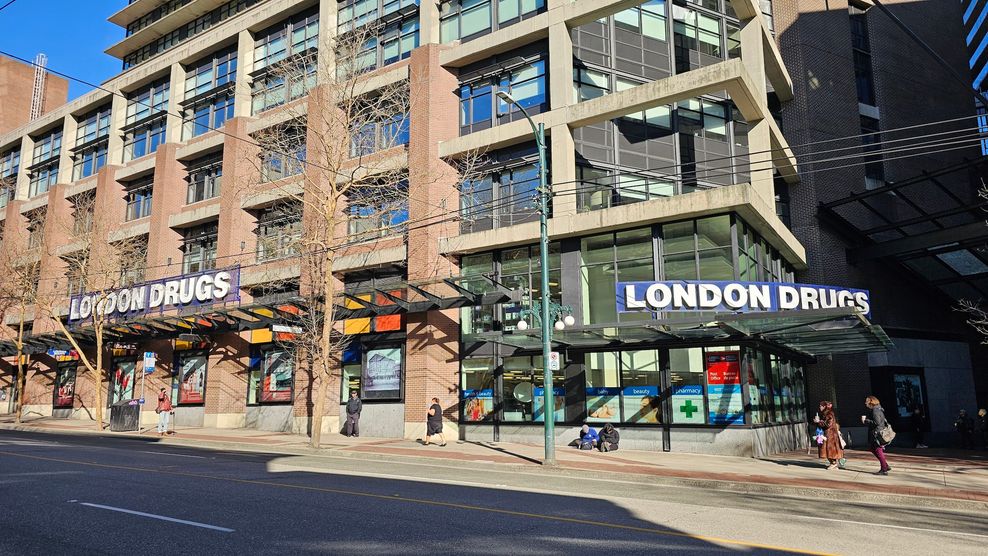
London Drugs at Woodward’s. (Kenneth Chan)
- You might also like:
- Downtown Eastside community wants more retail after London Drugs closure, not police
- Vancouver Police opening major patrol operations hub at Woodward's, while exploring training academy at former London Drugs space
- 'This area will not be safe': Vancouver residents decry lack of government action after London Drugs closure
- London Drugs at Woodward's to permanently close due to 'persistent safety incidents'
- Opinion: Refusing change is a choice, and it's keeping the Downtown Eastside in crisis