


How air cargo is driving Vancouver International Airport's evolution and growth beyond passenger travel


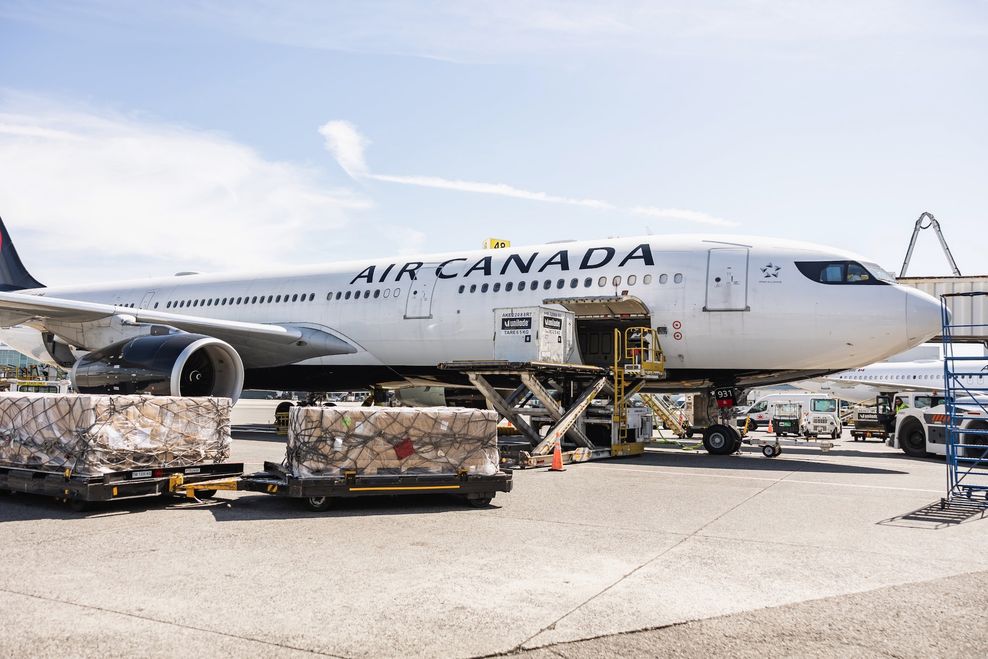
On a typical month in 2025, more than two million people passed through Vancouver International Airport (YVR) on their way to destinations across Asia, Oceania, Europe, and the Americas — unaware of the quiet economics that help keep so many of those flights in the air.
For many residents in British Columbia and other Canadians connecting through YVR, which is Canada’s second busiest and largest airport and the country’s Trans-Pacific gateway, this connectivity translates into an abundance of overseas travel options throughout the year — whether escaping on a spring break getaway, embarking on a long-planned summer vacation, or flying to visit family during the winter holidays.
- You might also like:
- Inside the global competition to bring new airlines and routes to Vancouver International Airport
- Vancouver International Airport aiming to be an industrial and multi-modal transportation hub
- $74 million in federal funding to expand Vancouver International Airport's cargo facilities
- Traffic data from AI-powered sensors used to consider new replacement bridge to Vancouver International Airport
- AI-powered cameras to transform real-time ground operations at Vancouver International Airport
- Canada Post planning major expansion of processing facility at Vancouver International Airport
- Record three million passengers expected at Vancouver International Airport during the holiday travel season
Air cargo “subsidizes” commercial passenger flights
While passengers experience this global reach most visibly through flight schedules and ticket availability, a less obvious force plays a growing role in helping sustain it financially. Beneath the passenger cabin floor lies the aircraft’s lower cargo hold, carrying not only checked baggage but also commercial freight.
This cargo, transported on commercial passenger flights, helps make routes economically viable and can ease pressure on ticket prices by offsetting some of the airline’s costs of operating the service — just like a subsidy.
In fact, the bellies of commercial passenger aircraft carry the majority of the world’s air cargo, not dedicated air freighter aircraft. According to the latest global air cargo report by International Air Transport Association (IATA), over the period from January to October 2025, belly-hold cargo in commercial passenger aircraft accounted for 54.3 per cent of total international freight — representing an increase from the same period in 2024 — with the remaining 45.7 per cent carried by air freighters, such as the planes flown by FedEx, UPS, Purolator, DHL, Cargojet, Amazon Air, and other operators.
In contrast, according to Vancouver Airport Authority, in 2024, about 60 per cent of YVR’s air cargo was moved in the bellies of commercial passenger aircraft, while the remaining 40 per cent were moved on dedicated air freighters.
Over this period, according to IATA, global air cargo volumes in the belly-hold of commercial passenger aircraft grew by 6.4 per cent year-over-year.
Notably, cargo carried in the belly holds of commercial passenger aircraft surged by an exceptional 24 per cent on flights between North America and Asia during the first 10 months of 2025, compared with the same period in 2024. At the same time, total air cargo volumes — both passenger aircraft and dedicated air freighters combined — edged slightly lower overall. This decline reflects the weak economic climate, particularly the impact of U.S. tariffs on Chinese goods and regulatory changes that have dampened e-commerce demand and reduced air freighter capacity.
As a result, the restructuring of Trans-Pacific supply chains has shifted a greater share of air cargo into the bellies of commercial passenger aircraft. According to IATA, on routes between North America and Asia, growth in belly-hold cargo capacity on passenger flights has helped offset reductions in dedicated air freighter service.
“Cargo is very price sensitive, in many cases it’s low value and better served by ship or truck but when the market see a geopolitical event or a typical trade lane impacted then air cargo can once again come into its own,” John Grant, a partner with MIDAS Aviation and the chief data analyst for OAG Aviation, told Daily Hive Urbanized.
He also noted that “the dedicated cargo operators follow the market, [and] there are few routes with cargo demand in both directions and therefore those operators frequently move their aircraft to where the next consignment is waiting.”
During the pandemic, he added, some carriers even flipped their operations to support cargo services, but that was a short-lived situation for only a few years. Increased air shipments during this period were also partly buoyed by tremendous backlogs in marine shipping. At the time, when air passenger volumes at the peak of the pandemic were just a small fraction of normal and e-commerce orders swelled, some airlines sought to secure more wide-bodied cargo capacity.
But Grant also emphasized that added revenue from cargo in the belly-hold of commercial passenger aircraft can make all the difference on whether an airline is able to financially sustain that route.
“Cargo is certainly an important part of the revenue mix for scheduled airlines with long-haul networks and indeed through trucking operations their short-haul operations. I know of some routes where the cargo contribution is literally the make or break of the service, particularly if the cargo is high yield and low volume such as perishable products,” continued Grant.
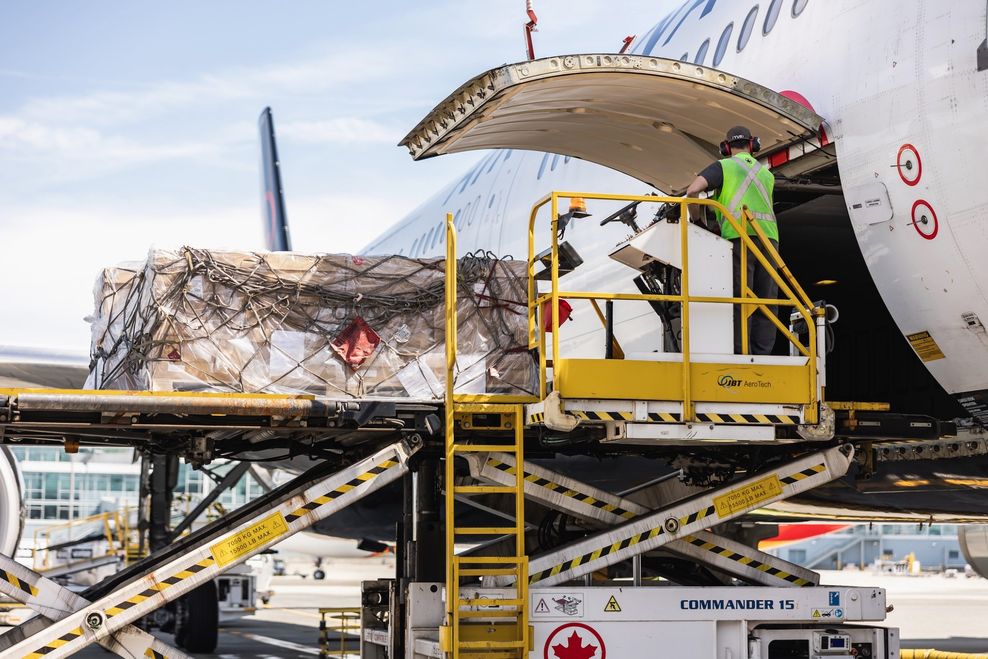
Commercial cargo being loaded into the belly hold of an Air Canada passenger aircraft. (Vancouver International Airport)
YVR’s strengths in seafood and produce cargo
For the same geographic reasons YVR has become a Trans-Pacific hub for passengers travelling between Asia and Oceania and North America, it is also a pivotal hub for cargo — just like Canada’s largest port, the Port of Vancouver, handling of cargo by ships.
However, air cargo is different from ship cargo, as it typically relates to the transport of high value goods — such as live/iced seafood, produce, and mining equipment for exports, and electronics, health supplies, e-commerce, and perishable goods for imports.
YVR saw 339,000 tonnes of cargo move through its facilities in 2024, marking an all-time annual record for the airport’s cargo volumes. Furthermore, YVR’s 2024 cargo volumes represent a strong 8.6 per cent year-over-year growth — well above that year’s national average increase of 5.2 per cent.
In 2025, the airport is expected to break all-time annual records for both passenger volumes — exceeding its previous record of 26.38 million passengers in 2019 — and cargo volumes. Over the first 10 months of 2025, over 290,000 tonnes of cargo have already moved through the airport — not even accounting for the busiest months of November and December 2025, which typically see higher cargo volumes from the seasonal spike in e-commerce activity and other holiday-related factors.
YVR’s cargo business and the port are also supported by the region’s highways and freight railway network to other areas of the province and continent.
Some of B.C.’s global-leading seafood harvesting and produce growing industries have specifically helped drive YVR’s uniquely relatively large air cargo demand for perishable items.
According to the federal government’s Department of Fisheries and Oceans Canada, based on averages between 2018 and 2024, B.C.’s top live/iced seafood export destinations are the United States (39 per cent), China (35 per cent), Japan (eight per cent), and Hong Kong (five per cent). Furthermore, B.C.’s top live/iced seafood species exports are Dungeness and Red Rock crabs (26 per cent), salmon (17 per cent), hake (nine per cent), prawn and shrimp (eight per cent), geoduck (seven per cent), and halibut (six per cent).
Dungeness is the primary species of crab harvested in B.C., with the commercial harvesting occurring year-round and spiking from October to March — when the crabs are fully grown, most abundant, and most desirable. Overall air cargo volumes at YVR during the fall and winter months are partly correlated to the seasonality of this major seafood export.
B.C. also exports significant volumes of produce to Asian markets, including blueberries, cherries, cranberries, apples, pears, peaches, and other tree fruits, which require timely air cargo transport. Outside peak periods for live crab exports, for example, these produce shipments — along with harvested salmon — help keep YVR’s air cargo operations busy through the summer and early fall, spreading demand more evenly throughout the year and making better use of available capacity for cargo.
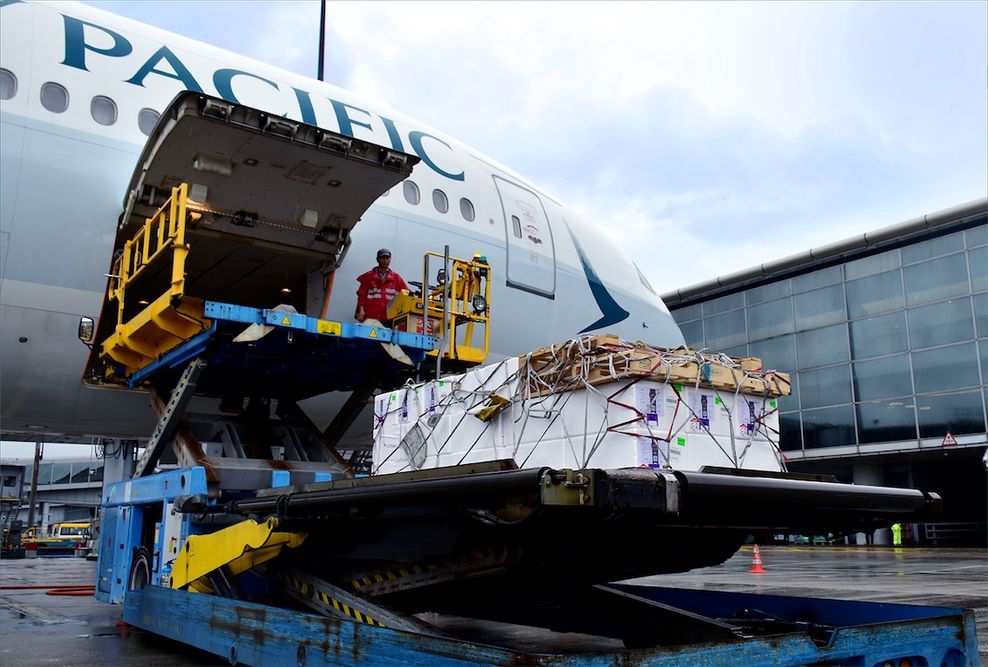
Cathay Pacific’s handling of perishable seafood cargo arriving at Hong Kong International Airport. (Cathay Pacific)
The federal government indicates that in 2023, B.C.’s seafood processing and wholesaling sector generated $244 million in annual GDP and $158 million in household income, supporting 2,600 full-time jobs. There are over 170 companies in the province that process and wholesale seafood, with about 110 located in the Lower Mainland — particularly in Richmond and Delta — generating nearly $900 million in revenue in 2023. Much of this is attributed to the overseas export market.
With all that said, recent geopolitical tensions with the U.S. and China have led to an overall decrease in such exports to key international markets.
In particular, China’s retaliatory tariffs earlier this year on Canadian seafood, pork, and agricultural products has led to a temporary rewind on the decades-long upswell rise in demand driven by urbanization and the growing middle-class demographic of Mainland China. Dungeness crab exports have fallen by as much as 60 per cent in 2025 compared to 2024, according to the B.C. Crab Fisherman’s Association.
But the added duties are not being applied for these Canadian goods headed directly to the businesses and residents of Hong Kong, which is a free port with its own independent trade regulations separate from those of Mainland China under the “one country, two systems” framework. To uphold its competitiveness as an international business hub, Hong Kong has not enacted any retaliatory tariffs against the U.S. or Canada.
Although far smaller than demand from Mainland China, B.C.’s perishable exports to Hong Kong are far from insignificant.
Prior to the current geopolitical tensions, Hong Kong — one of the world’s largest hubs for transportation by air and sea — has traditionally been a major entry point for B.C. exports to the overall Asian market, including perishable goods.
Hong Kong International Airport (HKG) is one of YVR’s most well-connected international routes, with 31 direct, non-stop, roundtrip flights per week between HKG and YVR — including 17 weekly flights on Cathay Pacific (multiple daily), seven on Air Canada (one daily), and seven on Hong Kong Airlines (one daily).
Frequent commercial passenger routes are particularly well suited to moving perishable air cargo, where speed, reliability, and flexibility matter more than sheer capacity.
Time-sensitive goods such as fresh seafood, produce, and flowers benefit from daily — or even multiple daily — departures, allowing shipments to move as soon as they are ready and reducing time spent on the ground, which is critical for preserving freshness and shelf life.
Passenger flight networks also make it easier to move perishable goods by linking smaller production areas to major international hubs, with plenty of backup connections if a direct, non-stop flight is unavailable.
On busy routes with multiple daily departures, such as HKG-YVR, there is an added safety net: if a shipment arrives to the airport late or a flight is delayed or cancelled, it can often be placed on the next available flight hours later. Because these planes are flying with passengers anyway, the cost of using space in the belly hold can be more predictable — and sometimes cheaper — than relying on dedicated air freighters during busier periods.
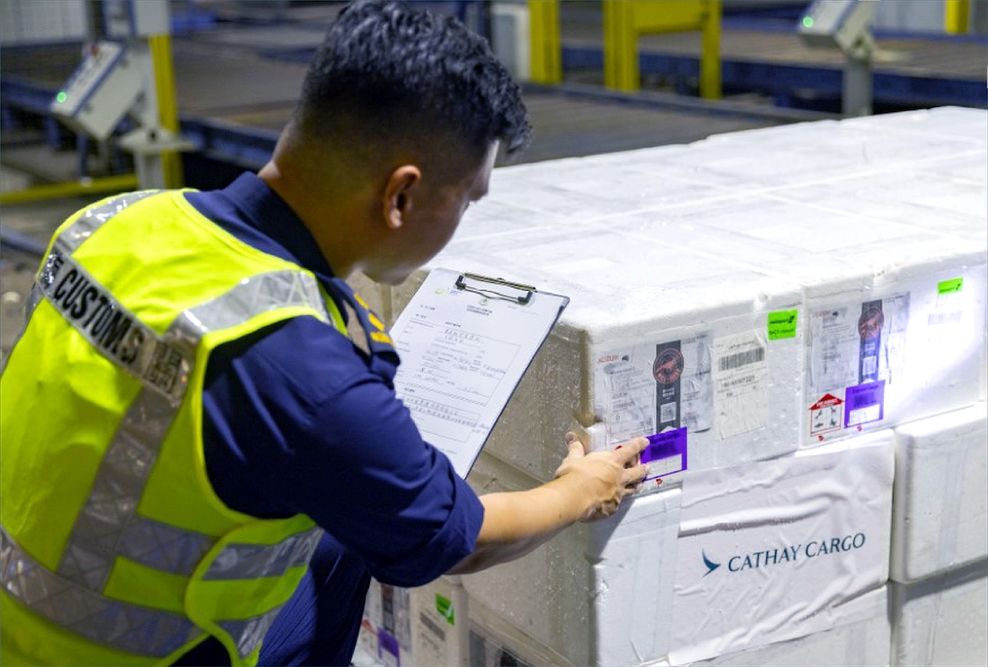
Cathay Pacific’s handling of perishable seafood cargo arriving at Hong Kong International Airport. (Cathay Pacific)
When it comes to perishable items specifically, Hong Kong flag carrier Cathay Pacific knows its home base at HKG holds a strategic advantage.
While the role of air cargo carried on commercial passenger aircraft is vitally important, the equation does not end when the aircraft lands. For highly time-sensitive goods, the so-called “Last Mile” on the ground — how shipments move quickly and safely from the airport to their final destination — can be just as critical as the flight itself.
This past summer, Cathay Pacific’s cargo operations strengthened that final link by launching a new “Air-Land Fresh Lane,” designed to move perishable goods more quickly from Hong Kong into Mainland China’s Greater Bay Area. This new process allows fruit, as well as live/iced seafood, arriving at HKG to be transferred directly onto temperature-controlled trucks and driven across the Hong Kong-Zhuhai-Macao Bridge, all under a single shipment document. New customs certifications and streamlined inspection procedures help shipments clear the border faster, reducing paperwork, delays, and costs for shippers.
Supported by Cathay Cargo’s experience and extensive purpose-built facilities in handling perishables and its end-to-end temperature-controlled processes, the Air-Land Fresh Lane helps ensure high-value, time-sensitive goods arrive fresh and ready for one of the world’s largest and most demanding consumer markets.
In an interview with Daily Hive Urbanized, Russ Atkinson, the director of air service development for the Vancouver Airport Authority, emphasized the strong performance of new and returning international services at YVR is not just a passenger story — it is equally a cargo one. While airlines like Japan Airlines-owned Zipair to Tokyo Narita International Airport have been performing well and newer entrants such as South Korea’s T’way Air to Seoul are still building their presence, Atkinson notes that these flights are already generating meaningful cargo activity.
He points to T’way’s inaugural service in particular, where discussions quickly turned to the movement of perishables.
“We were talking to their team about all the perishable goods, the exports that were going on — from cherries to seafood,” Atkinson said, underscoring how quickly cargo becomes part of the conversation when new long-haul routes launch.
That belly-hold capacity is a major reason YVR’s cargo volumes continue to climb. Atkinson says the airport’s recent strong cargo performance is in large part driven by the addition of new wide-body passenger flights.
“All this new wide-body passenger service and the belly space that it has on it is playing a huge role in keeping our province connected and boosting trade and the movement of goods between our respective regions,” he explained.
According to Atkinson, virtually every wide-body aircraft serving YVR — whether a Boeing 787 Dreamliner or a Boeing 777 — offers substantial space beneath the cabin floor for cargo. That space is not an afterthought, but a core part of how airlines evaluate new routes.
“When airlines are looking at these specific route opportunities, they’re looking at the business cases around whether there’s enough passenger demand,” he told Daily Hive Urbanized. “But a really important part of the equation is also the belly space. Are they going to be able to fill that up with goods?”
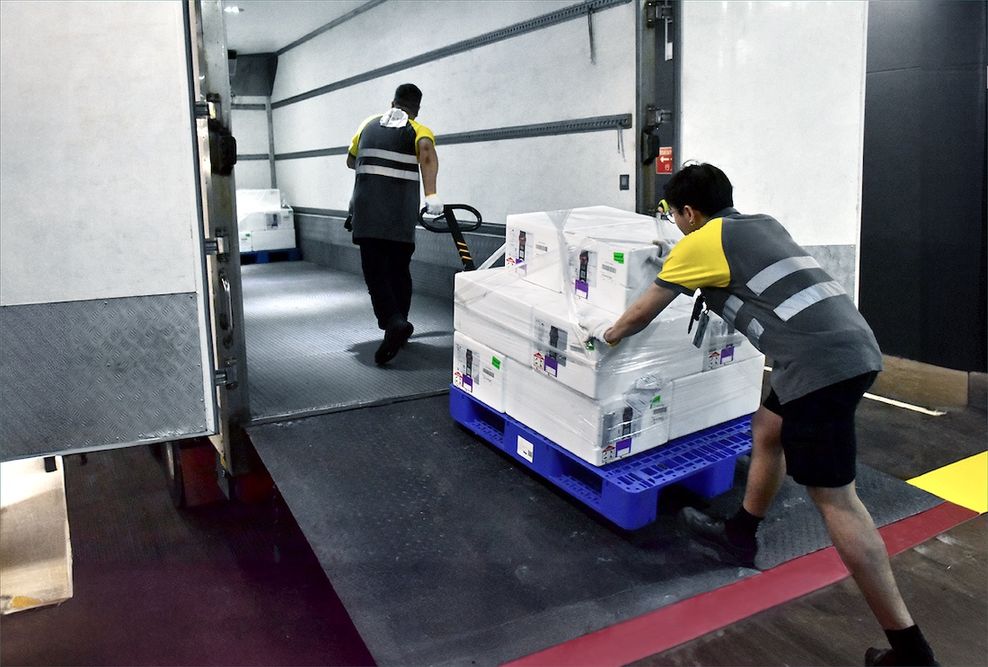
Cathay Pacific’s handling of perishable seafood cargo arriving at Hong Kong International Airport. (Cathay Pacific)
YVR already punches above its weight as a cargo hub
In 2024, HKG recorded annual totals of 53 million passengers and about five million tonnes of air cargo (on dedicated air freighters and in the bellies of commercial passenger aircraft combined). That means Hong Kong’s airport handles roughly one tonne of air cargo for every ten passengers it serves each year — among the highest air cargo-to-passenger ratios in the world, if not the highest (again, not to be confused for checked luggage).
YVR’s handling of 339,000 tonnes of air cargo alongside 26.2 million passengers in 2024 equates to roughly one tonne of cargo for every 77 passengers.
That ratio places YVR well ahead of all major Canadian airports.
Toronto Pearson International Airport, Canada’s largest airport by passenger volume, handled 441,500 tonnes of cargo with 46.8 million passengers, translating to one tonne per 106 passengers. Montreal-Trudeau International Airport processed 172,000 tonnes alongside 22.4 million passengers, or one tonne per 130 passengers, while Calgary International Airport recorded 124,000 tonnes with 18.9 million passengers, or about one tonne per 152 passengers.
At the smaller end, notable for its geographic location, Halifax Stanfield International Airport handled 26,000 tonnes of cargo and four million passengers, equating to roughly one tonne per 154 passengers.
Even when compared with other major airports and global hubs, YVR’s cargo performance stands out.
By comparison, Seattle-Tacoma International Airport moved about 460,000 tonnes of cargo with 52.6 million passengers in 2024, or roughly one tonne for every 114 passengers.
Los Angeles International Airport handled 2.4 million tonnes of cargo with 76.6 million passengers, or about one tonne per 32 passengers, reflecting not only the size and economic significance of the Southern California area but also the airport’s role as a major global freight gateway. Hartsfield-Jackson Atlanta International Airport handled approximately 646,000 tonnes of air cargo alongside 108.1 million passengers, equating to roughly one tonne of cargo for every 167 passengers.
Singapore Changi Airport posted a similar ratio, moving two million tonnes with 67.7 million passengers, or roughly one tonne per 34 passengers. London Heathrow Airport, Europe’s largest cargo airport by value, processed 1.58 million tonnes alongside 83.9 million passengers, or approximately one tonne per 53 passengers.
Taken together, the figures show that while YVR does not approach the absolute cargo volumes of the world’s largest hubs, it carries a disproportionately high amount of freight relative to its passenger traffic.
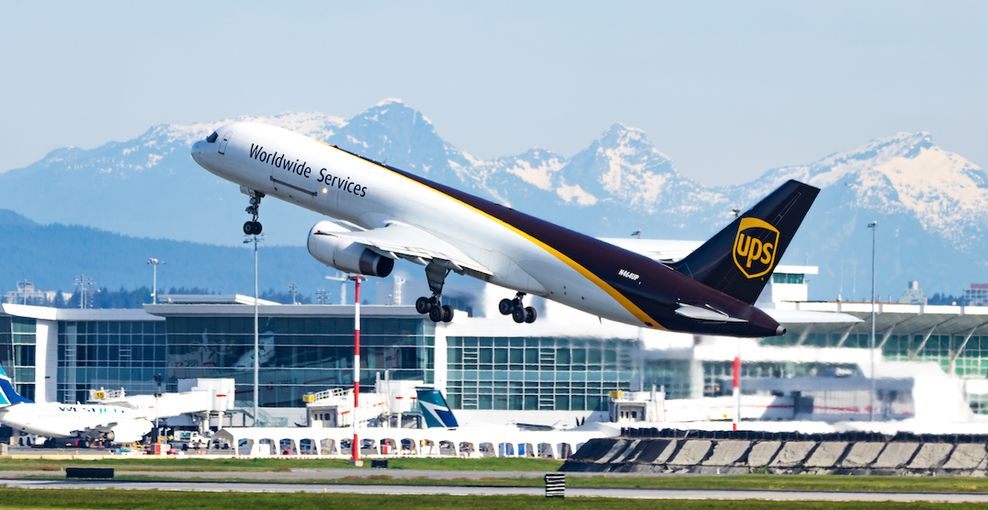
UPS cargo aircraft at Vancouver International Airport. (The Bold Bureau/Shutterstock)
For Vancouver Airport Authority, that relative strength in cargo is a critical part of building a resilient and diversified revenue base.
Overall cargo activity generates income through landing fees, terminal and handling charges, ground leases, and logistics-related services that are not directly tied to passenger volumes or seasonal travel patterns. Unlike passenger traffic, which can fluctuate sharply with economic cycles, shifts in tourism demand, global pandemics, and aviation-based terrorism, cargo tends to be comparatively steadier and often counter-cyclical, supported by global trade, e-commerce, and essential goods, according to IATA.
This diversification matters. By growing its cargo business, YVR reduces its reliance on passenger revenues alone, helping stabilize finances during downturns while supporting continued reinvestment in the airport. In that sense, cargo growth not only keeps goods moving — it helps ensure the long-term resilience of the airport itself.
A strong cargo operation also reinforces YVR’s role in the regional economy, supporting exporters, supply chains, and time-sensitive industries across B.C., enabling the province to diversify its exports.
Earlier in the post-pandemic rebound, the airport authority’s leadership shared a vision for YVR’s growth increasingly revolving around cargo and logistics as much as passengers.
Recognizing the strategic opportunity presented by its location and international cargo volumes, YVR is looking to advance a multi-modal cargo transportation strategy on Sea Island, transforming land once reserved for future runway expansion into industrial, warehouse, and commercial uses to support cargo growth. In 2021, the airport authority announced plans to develop hundreds of acres of vacant strips of airside areas north of the North Runway and south of the South Runway for trade — enabling warehouses, logistics facilities, light industrial space, and other commercial development that would complement aviation operations and generate additional non-aeronautical revenue.
This shift reflects broader investments in air cargo infrastructure at YVR, supported by $74 million in federal funding — announced in early 2024 — toward the $150-million project of expanding the airport’s cargo capacity by an additional 160,000 tonnes, representing an overall capacity increase of 50 per cent.
The expanded cargo-handling capacity will reach completion in 2027, while the remaining components of a taxiway extension, cargo apron extension, and road improvements will reach completion in 2028. The apron component entails four additional aircraft stands to accommodate Boeing 777 freighter aircraft — deemed to be the most fuel-efficient dedicated air freighters.
As well, this project currently under construction includes site preparation for the future construction of a new 270,000 sq. ft. cargo warehouse — a facility that will be leased to a logistics company for cargo sorting, processing, and storage — and will allow future dike raising work.
Upon completion, YVR’s expanded facilities for cargo represent a $22 billion increase to Canada’s trade potential per year — nearly doubling the $19-billion value of air cargo that moved through the airport in 2024.
The emphasis on improved cargo facilities — alongside growth in supply chain and processing infrastructure such as a potential expansion to the Canada Post Pacific Processing Centre next to the North Runway — positions YVR as more than just a node for flights: it is becoming a multi-modal logistics hub that links air, truck, and future industrial flows directly on Sea Island.
As well, the airport authority is introducing artificial intelligence-powered camera systems to monitor real-time ground operations at the aircraft gates of the terminal building. This will improve the efficiency and on-time performance of ground operations, including the loading of cargo into commercial passenger aircraft.
Early planning is underway by the airport authority and the provincial government to potentially replace the Moray Bridge — an aging swing bridge with two critically important arterial eastbound-only vehicle traffic lanes — located near the south end of the Arthur Laing Bridge, connecting to Sea Island Way in the Bridgeport area of Richmond. While optimal road connections are vital for freight truck movements, there are also early ideas with using barges to travel up and down the Fraser River to reach industrial lands, potentially as far as the rail hub in Mission. This would enable certain cargo to bypass congested roads.
By repurposing land once eyed for long-term runway expansion and focusing development on cargo-oriented facilities, YVR is diversifying its business model and revenue streams at a time when airports around the world are rethinking their role in global trade. This strategy not only supports timely movement of cargo, but also strengthens the airport’s resilience and economic contribution to B.C. by tapping into broader supply chain networks that extend far beyond gate numbers and passenger terminals.
- You might also like:
- Inside the global competition to bring new airlines and routes to Vancouver International Airport
- Vancouver International Airport aiming to be an industrial and multi-modal transportation hub
- $74 million in federal funding to expand Vancouver International Airport's cargo facilities
- Traffic data from AI-powered sensors used to consider new replacement bridge to Vancouver International Airport
- AI-powered cameras to transform real-time ground operations at Vancouver International Airport
- Canada Post planning major expansion of processing facility at Vancouver International Airport
- Record three million passengers expected at Vancouver International Airport during the holiday travel season