


Vancouver International Airport achieves all-time historic annual record of 26.9 million passengers in 2025


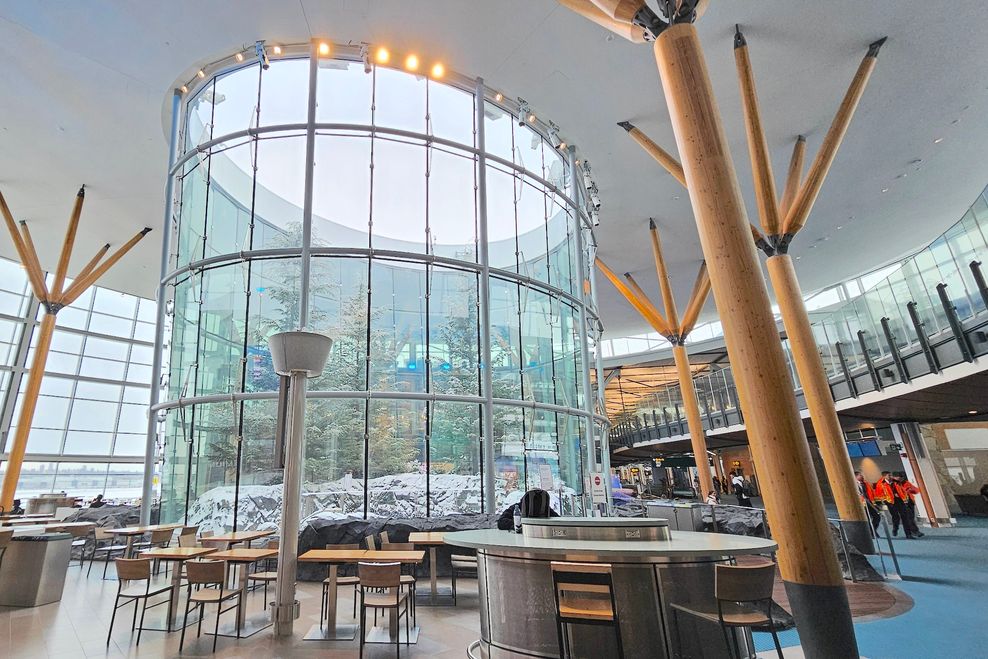
Vancouver International Airport (YVR) reached all-time historic annual highs in both passenger traffic and freight cargo volumes in 2025, cementing its position as Canada’s second-busiest airport and its role as a key gateway between North America and Asia.
Even with the climate of economic uncertainty and lower immigration, the airport welcomed 26.914 million passengers last year, representing a 2.7 per cent increase from 26.205 million passengers in 2024 and the highest total in YVR’s 94-year history. The previous record of 26.38 million passengers was set in pre-pandemic 2019.
YVR was only about 86,400 passengers away from reaching 27 million passengers in 2024 — equivalent to roughly a single day’s worth of passengers. Throughout the year, the airport saw an average of 73,736 passengers stream through its terminal facilities on a daily basis.
- You might also like:
- Inside the global competition to bring new airlines and routes to Vancouver International Airport
- How air cargo is driving Vancouver International Airport's evolution and growth beyond passenger travel
- Vancouver International Airport sees resurgence in passenger volumes from Mainland China market
- AI-powered cameras to transform real-time ground operations at Vancouver International Airport
- Vancouver International Airport to expand new no-unpack screening machines at all security checkpoints in 2026
The airport also set monthly passenger records in nine months of the year, with February, April, and August being the only exceptions. Monthly totals below two million are now increasingly rare, as YVR in 2025 recorded passenger volumes exceeding two million in 10 separate months, with the remaining two months surpassing 1.9 million and approaching the two-million mark.
The 2.66 million passengers recorded in July 2025 marked the third-highest monthly total in YVR’s history, trailing the 2.68 million passengers recorded in August 2019 and 2.71 million in August 2018. For the month of August 2025, the airport saw 2.65 million passengers — a month particularly impacted by Air Canada’s labour disruptions.
YVR closed 2025 with 2.187 million passengers in December — just 2,762 passengers more than December 2024.
All-time records for domestic and Europe, while Asia Pacific leads growth
Domestic passenger volumes in 2025 reached a new all-time record of 13.35 million, surpassing the previous record of 12.86 million in 2024 and representing a 3.8 per cent year-over-year growth.
Passenger volumes for the Asia Pacific market grew exceptionally by 15.6 per cent year-over-year, reaching 4.47 million passengers in 2025. This was YVR’s second-best year ever for Asia Pacific passenger volumes, coming just behind the previous record of 4.59 million passengers in 2019.
YVR’s European market saw 1.78 million passengers in 2025, representing a strong growth of 6.3 per cent year-over-year. This was another all-time record breaker, exceeding the previous record of 1.76 million in 2019.
“Strong operations and customer service combined with globally recognized innovation generated record results in 2025,” said Tamara Vrooman, president and CEO of Vancouver International Airport.
“I recognize and thank our outstanding YVR and Sea Island employees, our partners at Musqueam, as well as our airline customers and passengers for contributing to this achievement.”
Although there are economic headwinds, continued strong tourism is supporting YVR. Preliminary data from Destination Vancouver indicates that 2025 was a strong year for tourism in Vancouver, with more than 10.3 million overnight visitors recorded in the first 10 months of the year — a 0.6 per cent increase compared with the same period in 2024, which was a record-breaking year.
A year of major new routes and service restarts
In 2025, YVR expanded its air service network with a mix of returning and new routes that strengthened connectivity across Asia, North America, and key domestic markets.
Three major Asian services resumed, including Air Canada to Beijing and China Southern and China Eastern flights to Guangzhou and Shanghai.
Vancouver Airport Authority officials previously told Daily Hive Urbanized that there was a resurgence in demand from Mainland China in 2025, reflected not only in direct, nonstop routes but also in increased passenger traffic connecting through Hong Kong International Airport and other major Asian hubs.
Prior to the pandemic, and before Canada-China political and economic relations significantly deteriorated, Mainland China accounted for a substantial share of YVR’s overall Asia Pacific market, with the airport offering more direct, non-stop flights to Mainland China than any other North American airport — a network that has yet to fully recover, in part because Chinese carriers were among the very last to fully restart operations emerging out of the pandemic. Earlier this month, amid improving relations, the Government of China’s decision to remove the visa requirement for Canadian travellers could further boost demand moving forward.
YVR also welcomed 13 new routes in 2025, highlighted by T’Way Airlines’ launch of service to Seoul, multiple new Air Canada destinations spanning Asia, the U.S., Mexico, and Canada, and additional routes from WestJet, Flair Airlines, Porter Airlines, and Pacific Coastal.
Together, these additions reinforced YVR’s role as a major hub linking British Columbia to global and regional markets.
“Looking forward, YVR is ready to go to welcome additional flights and carriers to get more of Canada to global markets while at the same time creating jobs and opportunity here at home,” continued Vrooman.
“As governments look to sign new bilateral and trade agreements, we are on the ground in those emerging markets, engaged with our partners, building new relationships today to be ready for that additional growth tomorrow.”

Vancouver International Airport’s (YVR) booth at the 2025 Routes World conference in Hong Kong. (Kenneth Chan)
Weight of U.S. transborder dip brings down YVR’s overall international growth
The only market to record a year-over-year decline in passenger volumes was United States transborder travel, which fell by 7.1 per cent — from 6.63 million passengers in 2024 to 6.16 million in 2025.
All things considered, and given the current Canada-U.S. political climate and broader economic tensions, the 2025 U.S. transborder passenger volume remained relatively strong.
Aside from the pandemic years from 2020 to 2022, YVR has regularly exceeded over six million U.S. transborder passengers annually since 2018. U.S. transborder volumes also helped propel YVR’s early post-pandemic recovery.
However, the decline in U.S. transborder travel last year weighed on YVR’s overall international growth, which rose by a modest 1.6 per cent — from 13.35 million passengers in 2024 to 13.57 million in 2025.
Some of the declines in U.S. transborder travel were likely offset by increased domestic travel and higher levels of non-U.S. international travel among Canadians. Canadian airlines also pulled back some U.S. capacity and redirected aircraft and resources toward domestic and non-U.S. international destinations.
U.S. transborder volumes are being sustained by Americans still visiting Canada in significant numbers, with the low Canadian dollar providing a major advantage.
As well, Vancouver is also a primary homeport for Alaska cruise ships, with the Canada Place cruise ship terminal recording a very strong figure of 1.2 million cruise passengers in 2025, and the majority being U.S. residents.
As Canada’s largest cruise ship port by a wide margin — and as both the start and end point for the vast majority of itineraries, given its homeport designation — this provides YVR with a significant advantage over other Canadian airports.
Freight moved by air sees new all-time record
YVR’s freight cargo activity — not to be confused with the checked baggage of passengers — also reached an all-time high, with 365,000 tonnes of goods moving through the airport in 2025, representing a 7.4 per cent year-over-year increase. This exceeds the previous record of 339,000 tonnes in 2018.
The growth in freight demonstrates the airport’s importance to local and national supply chains, particularly for high-value, time-sensitive and perishable exports.
According to the airport authority, YVR processes approximately 15 per cent of Canada’s total air cargo volumes and contributes an estimated $15 billion annually to the country’s GDP.
Notably, about 60 per cent of YVR’s air cargo is transported in the belly holds of commercial passenger aircraft, with the remaining 40 per cent moved by dedicated freighters. Belly-hold cargo volumes can be a critical factor in route viability, as they strengthen the business case for launching and sustaining services and, in some cases, can even make or break a commercial passenger route. This additional revenue can help offset operating costs, easing upward pressure on passenger fares and effectively subsidizing some ticket prices.
Due to its advantageous geographic location, YVR punches above its weight in air cargo volumes compared with other Canadian airports and even handles cargo volumes comparable to those of some major global hubs with far greater passenger volumes.
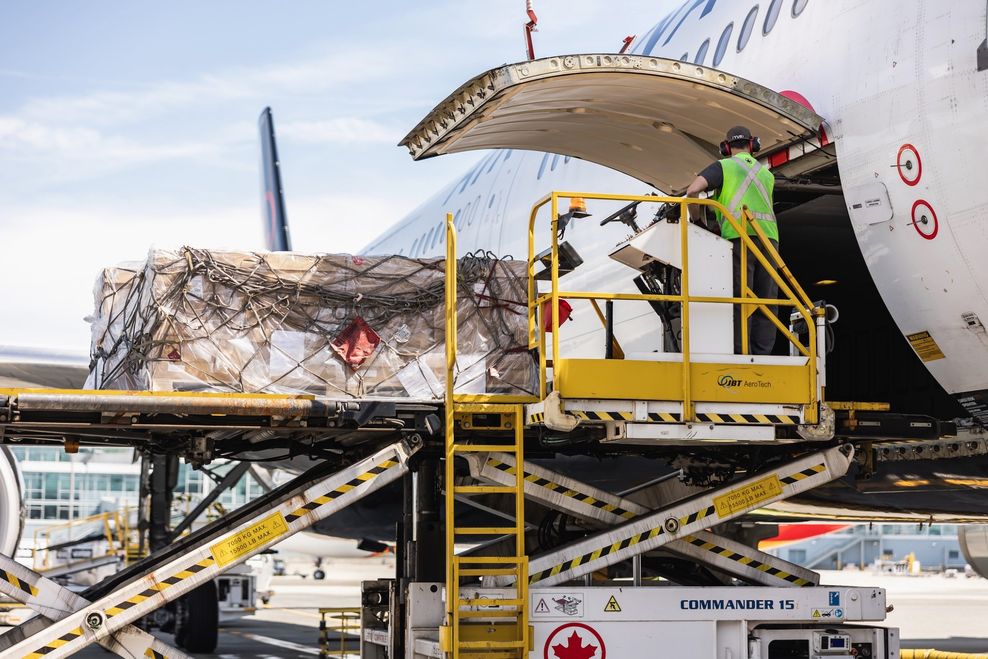
Commercial cargo being loaded into the belly hold of an Air Canada passenger aircraft. (Vancouver International Airport)
- You might also like:
- Inside the global competition to bring new airlines and routes to Vancouver International Airport
- How air cargo is driving Vancouver International Airport's evolution and growth beyond passenger travel
- Vancouver International Airport sees resurgence in passenger volumes from Mainland China market
- AI-powered cameras to transform real-time ground operations at Vancouver International Airport
- Vancouver International Airport to expand new no-unpack screening machines at all security checkpoints in 2026